On this page
What US customs clearance involves
Customs clearance is how U.S. Customs and Border Protection (CBP) admits imported goods into U.S. commerce. For a commercial shipment, an entry is filed declaring what the goods are, where they were made, what they are worth and who is importing them.
CBP, and any partner government agency that regulates the product, reviews that declaration, may examine the cargo, and then releases it. The duties, taxes and fees are deposited at entry and finalized later, when CBP liquidates the entry.
Airlift USA is an FMC-licensed NVOCC and freight forwarder (OTI license 016162), not a customs broker. Your entries are filed through our licensed customs-broker network under a power of attorney from you, the importer of record.
What we add is coordination. The ISF, the arrival notice, the entry documents, the duty estimate, any exam CBP orders and the trucking afterwards are handled by one team that already holds your shipment file, as we have done on ocean and air imports since 1999.
What the service includes
- HTS classification reviewed before the goods ship, so you know the duty rate before the invoice is final.
- Importer Security Filing for ocean shipments, filed by Airlift as the NVOCC.
- Your documents checked against each other: commercial invoice, packing list, bill of lading or air waybill, certificates of origin and any agency paperwork.
- Entry (CBP Form 3461) and entry summary (CBP Form 7501) filed through the licensed broker network in ACE, with a bond arranged through the broker for first-time importers.
- A duty, tariff, MPF and HMF estimate before arrival, so you can fund the deposit before the entry summary is due.
- Partner-agency coordination where the commodity needs it: FDA prior notice, CPSC certificates, USDA/APHIS, FCC, EPA and DOT declarations.
- Exam coordination if CBP orders one, including the move to and from the examination station.
- Release, delivery order and drayage or air pickup arranged by the same team, so the container or ULD (air cargo pallet or container) moves as soon as CBP and the carrier release it.
Do I need a customs broker?
Not by law. An importer transacting customs business solely on its own account does not need a licence (19 CFR 111.2(a)(2)(i)); anyone transacting customs business on behalf of someone else must hold a customs broker licence issued by CBP (19 CFR 111.2(a)(1)). CBP’s own guidance to new importers says there is no legal requirement to hire a broker.
In practice most importers use a licensed customs broker. Entries are transmitted electronically in ACE, the bond and power of attorney have to be in place, and classification, valuation and partner-agency data are specialist work. Whoever files, the importer of record stays responsible for the entry and for the duties.
Airlift USA is not a customs broker. We are the FMC-licensed NVOCC and forwarder on your shipment, and your entries are filed by licensed customs brokers in our network. The table below shows who does what.
Who does what on a US import
Swipe sideways to see every column →
| Task | Who does it |
|---|
| Ocean freight, house bill of lading and arrival notice | Airlift (NVOCC) |
| Importer Security Filing (ISF) for ocean cargo | Airlift, as the NVOCC, or another agent of the importer |
| Collecting and cross-checking the invoice, packing list and bill of lading | Airlift, with the broker |
| Power of attorney, HTS classification and valuation on the entry | Licensed customs broker |
| Entry (CBP Form 3461) and entry summary (CBP Form 7501) in ACE | Licensed customs broker (or an importer self-filing on its own account) |
| Customs bond | Surety, arranged through the broker in the importer’s name |
| Paying duties, taxes and fees | Importer of record, usually through the broker |
| Exam moves, freight release and drayage | Airlift |
| Responsibility for the entry being correct | Importer of record |
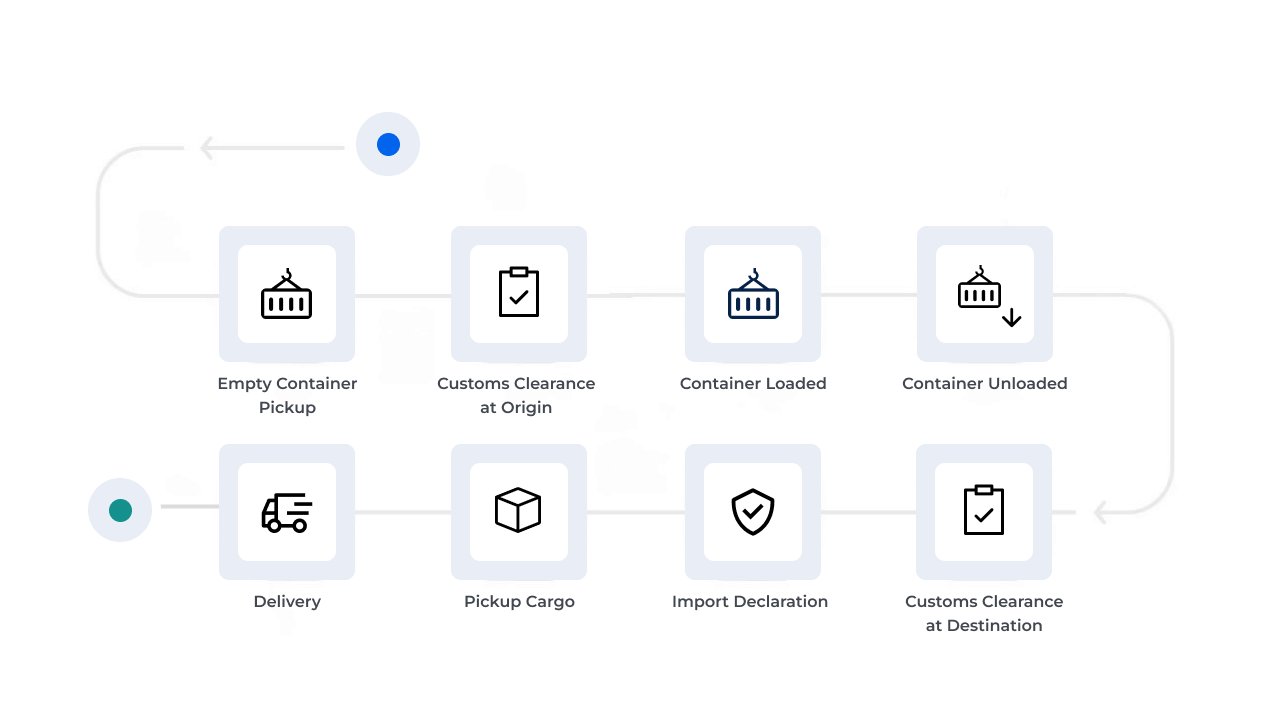
The US import entry process, step by step
The deadlines below are CBP’s outer limits, not the plan. In practice the broker files the entry before the vessel or aircraft arrives, so CBP can release the cargo on arrival.
- Before loading (ocean only): Importer Security Filing. The ISF must reach CBP no later than 24 hours before the cargo is laden aboard the vessel at the foreign port (19 CFR 149.2). It is the importer’s filing, made by the importer or an agent; Airlift files it for the ocean shipments it carries. Air cargo has no ISF: the carrier sends advance cargo data instead (see air versus ocean below).
- In transit: documents, classification and duty estimate. The broker receives the commercial invoice, packing list and bill of lading or air waybill, confirms the HTS classification and country of origin, and estimates the duties, tariffs, MPF and HMF due. The carrier issues an arrival notice with the arrival date, free time and any charges to be paid before release.
- Arrival and entry: CBP Form 3461. Merchandise must be entered within 15 calendar days after landing from the vessel, aircraft or vehicle, or after arrival at the port of destination for in-bond cargo (19 CFR 142.2). The entry (CBP Form 3461, or its electronic equivalent in ACE, CBP’s filing system) declares the goods and asks for release. CBP either releases the shipment or places a hold for documents, a partner agency or an exam.
- Entry summary and duty deposit: CBP Form 7501. The entry summary, with the estimated duties, taxes and fees, is filed within 10 working days after the time of entry (19 CFR 142.12(b)). Many brokers file the entry and entry summary together before arrival. Either way, the duty deposit has to be funded by then.
- Release and delivery. Once CBP has released the entry and the carrier has released the freight (freight paid, original bill of lading surrendered or telex release received), the container or air cargo can be picked up. Terminal free time runs from discharge, so if either release is late, demurrage starts.
- Liquidation. Liquidation is CBP’s final calculation of the duty on the entry. An entry not liquidated within one year of the date of entry is deemed liquidated at the rate and amount asserted by the importer of record, unless CBP extends the period; extensions cannot run past four years (19 U.S.C. 1504). Antidumping and countervailing duty entries commonly stay open longer because the final rate is set after the Commerce review.
Typical clearance timeline for an ocean import
This is the order things happen in and the latest CBP allows for each step. It is not a promise of speed: how long release takes depends on the documents, the commodity, any partner agency and whether CBP orders an exam.
Swipe sideways to see every column →
| Step | When | Who |
|---|
| Importer Security Filing | No later than 24 hours before the cargo is laden aboard the vessel at the foreign port (19 CFR 149.2(b)). | Importer or its agent; Airlift files it as the NVOCC. |
| Arrival notice | Before the vessel arrives. | Carrier or NVOCC. |
| Entry (CBP Form 3461) | May be filed before arrival (19 CFR 142.2(b)), and must be filed within 15 calendar days after landing (19 CFR 142.2(a)). | Licensed customs broker, or the importer on its own account. |
| Release | After CBP, and any partner agency that regulates the goods, has reviewed the entry, or after an exam if one is ordered. | CBP and partner agencies. |
| Entry summary (CBP Form 7501) and duty deposit | Within 10 working days after the time of entry (19 CFR 142.12(b)); often filed together with the entry. | Licensed customs broker, funded by the importer. |
| Liquidation | Normally within one year of entry, unless CBP extends or suspends it (19 U.S.C. 1504). | CBP. |
Filing the entry before the vessel arrives is the step that most often lets cargo be released on arrival. Every hold or exam adds days, not hours.
Entry documents for US customs clearance
CBP lists the entry documents in 19 CFR 142.3: the entry form, evidence of the right to make entry, a commercial invoice, a packing list where appropriate, and any documents another federal agency requires for the shipment. In practice, a clean file has these:
- Commercial invoice. Seller and buyer, a plain-language description of each item, quantity, unit and total value with currency, terms of sale and country of origin. Valuation and classification are based on it, so the description has to match the packing list and the bill of lading.
- Packing list. Cartons, pieces, weights and dimensions per line. CBP uses it to reconcile an exam with the invoice, and the terminal uses it for the piece count.
- Bill of lading or air waybill. The transport document is your evidence of the right to make entry. For NVOCC ocean shipments that is the house bill of lading Airlift issues; for air it is the house air waybill.
- Arrival notice. Issued by the carrier or NVOCC before arrival: vessel or flight, arrival date, location, free time and the charges that must be settled before freight release.
- Entry (CBP Form 3461). The request for release, filed in ACE by the broker. It lists the importer, the goods, the port and the bond, and can be filed before the goods arrive.
- Entry summary (CBP Form 7501). The declaration of HTS classification, value, country of origin and the duties, taxes and fees owed, filed with the duty deposit within 10 working days after entry (19 CFR 142.12(b)).
- ISF confirmation (ocean). The ISF transaction number, matched to the bill of lading, so the broker can confirm the filing is on record before the entry is transmitted.
- Power of attorney. A customs broker must hold a valid power of attorney before transacting customs business in the importer’s name (19 CFR 141.46). Sign it before the first shipment departs, not after it arrives.
- Certificate of origin or free-trade-agreement claim. Only where a lower “Special” column rate is claimed under an agreement or preference program. Without the claim on the entry, the column 1 general rate applies.
- Partner-agency documents. FDA prior-notice confirmation for food, a Children’s Product Certificate for children’s products, EPA and DOT declarations for vehicles and engines, the Lacey Act declaration for plant products, APHIS permits and phytosanitary certificates where required.
- Customs bond. A continuous bond already on file with CBP, or a single-transaction bond purchased for this entry. No bond, no release (19 CFR 142.4).
Customs bonds (continuous vs single entry) and the importer of record
A customs bond is a guarantee to CBP, backed by a surety, that the importer will pay the duties, taxes and charges due, complete the entry and redeliver the goods if CBP demands it (19 CFR 113.62). CBP will not release merchandise unless a single-entry or continuous bond on CBP Form 301 has been filed (19 CFR 142.4).
Shipments valued at $2,500 or less can often move under an informal entry (19 CFR 143.21). Above that, a formal entry with a bond is the norm for commercial goods.
- Continuous customs bond. Covers every entry the importer makes, at every port, for as long as it stays in force. CBP sets the minimum at the greater of $50,000 or 10 percent of the duties, taxes and fees the importer paid in the previous twelve months, in increments of $10,000 up to $100,000 and of $100,000 above that (CBP, How CBP Sets Bond Amounts, February 2024). Because its conditions include the ISF (19 CFR 113.62(j)), it also covers the importer’s Importer Security Filings. Importers with regular shipments are usually better served by a continuous bond.
- Single entry bond. CBP calls it a single-transaction bond. It covers one entry only. CBP sets it at not less than the entered value plus all duties, taxes and fees that apply, and at not less than three times the entered value for certain restricted merchandise (CBP Directive 3510-004). Suited to a one-off import. You pay the premium every time, so it stops making sense after a few entries.
- ISF bond. An ocean shipment’s Importer Security Filing needs a bond too (19 CFR 149.5(b)). A continuous importation bond covers it; an importer without one can post a dedicated ISF bond, and CBP claims liquidated damages for ISF violations against whichever bond is on file.
Importer of record: who can be one
The importer of record is the party that makes entry and answers to CBP for it. Under 19 U.S.C. 1484 the entry may be made by the owner or purchaser of the goods, or by a licensed customs broker designated by the owner, purchaser or consignee, and the importer of record must be one of those parties. CBP’s guidance to new importers is blunt: even when a broker files, the importer of record remains responsible for the correctness of the entry and for all duties, taxes and fees.
The importer of record also needs an importer number, filed on CBP Form 5106 with the first formal entry (19 CFR 24.5), a bond in its own name and a power of attorney to its broker. Set all three up before the first shipment departs. Leaving them until arrival is one of the most common causes of demurrage on a first import.
A foreign company can be the importer of record. A nonresident corporation must have a resident agent authorized to accept service of process in the state of the port of entry, and a bond with a resident corporate surety (19 CFR 141.18).
Duties, taxes and fees paid at entry
Everything below is charged on the goods, not the freight, which is why none of it appears in an ocean or air freight quote. The broker calculates the total on the entry summary, and the deposit is due with it.
Swipe sideways to see every column →
| Charge | How it is calculated | Applies to |
|---|
| Column 1 general duty | The rate in the “General” column of the Harmonized Tariff Schedule for the HTS subheading, applied to the entered value. Countries with normal trade relations pay this rate unless a lower “Special” rate is claimed under an agreement or preference program. CBP, not the importer, makes the final determination of the rate. | All entries |
| Section 301 duties | Additional duties administered by the U.S. Trade Representative on goods from named countries, China above all, charged on top of the column 1 rate. | By origin and HTS subheading |
| Section 232 duties | National-security tariffs imposed by presidential proclamation on products such as steel, aluminum, copper, automobiles, timber and unmanned aircraft, again on top of the normal duty. | By product, see the tariff-updates log |
| Antidumping and countervailing duties (AD/CVD) | Imposed where the Department of Commerce finds goods sold in the U.S. at unfairly low or subsidized prices; collected by CBP as a cash deposit at entry and finalized at liquidation, often years later. | Goods under an AD/CVD order |
| Merchandise Processing Fee (MPF) | 0.3464% of the entered value per formal entry, with a minimum of $34.58 and a maximum of $670.86 (FY2027, for entries from October 1, 2026). Informal entries pay a flat $2.77. | Ocean and air |
| Harbor Maintenance Fee (HMF) | 0.125% of the value of commercial cargo unloaded from a commercial vessel at a U.S. port (19 CFR 24.24). | Ocean only; not charged on air cargo |
Estimate the duty and tariffs for an HTS code and origin with the free tariff simulator, and check the tariff-updates log for measures in force before you price a shipment.
Partner government agencies that can hold a shipment
CBP releases the entry, but for many products another agency has to clear it first. The entry is flagged to that agency in ACE and its data or documents are filed with the entry. The agencies importers meet most often:
- FDA: food, drugs, devices and cosmetics. FDA reviews the entry and may examine or sample. Food also needs a Prior Notice, filed no more than 30 calendar days before arrival through CBP’s ACE (15 days through FDA’s own PNSI) and no less than 8 hours before arrival by water, 4 hours by air or rail, and 2 hours by road (21 CFR 1.279).
- FCC: radio-frequency devices. Anything with a radio, Wi-Fi, Bluetooth or a digital circuit has to meet one of the import conditions in 47 CFR 2.1204, normally a valid FCC equipment authorization for the device. The old FCC Form 740 import declaration is no longer required; the compliance itself still is.
- CPSC: children’s products. A Children’s Product Certificate, issued by the manufacturer or importer and based on third-party testing at a CPSC-accepted laboratory, certifies compliance with the applicable children’s product safety rules. From July 8, 2026, the certificate data is also eFiled with CBP at entry.
- USDA APHIS and the Lacey Act: plants, plant products, animals. Plants and many plant products need an APHIS import permit and a phytosanitary certificate from the country of origin. Plant products covered by the Lacey Act need a declaration giving the scientific name, country of harvest, quantity and value, filed in ACE or APHIS’s LAWGS system; paper PPQ 505 forms have not been accepted since January 1, 2026.
- EPA and DOT: vehicles and engines. A motor vehicle needs EPA Form 3520-1 and DOT Form HS-7 at entry; nonroad engines and equipment use EPA Form 3520-21.
Tell us the commodity when you book. Agency filings started after the goods land are the single most avoidable source of storage charges.
CBP exams: what happens and who pays
CBP can examine any shipment. Selection is by targeting: the parties, the commodity, the route, the filing history and random selection all feed it, and neither the broker nor the forwarder is told why. There are three levels of exam.
- Non-intrusive inspection (NII, often called VACIS or X-ray). The container or pallet is scanned at the terminal without being opened. Usually the quickest exam, with a terminal handling charge.
- Tailgate exam. The seal is broken and the doors opened at the terminal so an officer can look at the cargo at the back of the box.
- Intensive exam at a Centralized Examination Station. The container is trucked to a CES, a privately operated facility, not in the charge of a Customs officer, at which merchandise is made available to Customs officers for physical examination (19 CFR 118.1). The cargo is unloaded, the designated cartons opened, the officer inspects and may sample, and the container is reloaded and returned.
The importer bears the expense of preparing the merchandise for examination and closing the packages afterwards (19 CFR 151.6). CES charges, the drayage to and from the station and the demurrage or detention that accrues while the container waits are all billed to the importer, not to CBP.
Consistency is what reduces exam risk: the same description, quantity and parties on the invoice, packing list, bill of lading and ISF; a specific HTS classification and a defensible value; an ISF filed on time; and known, repeat parties in the supply chain.
CBP lists fewer CBP examinations and front-of-the-line inspections among the benefits of C-TPAT, its supply-chain security program. Airlift USA is a C-TPAT certified partner; importers who join the program in their own right get the benefit on their own entries.
Air versus ocean clearance: what changes
The entry is the same form, with the same duties and the same broker. What changes is the advance filing, the fees and, above all, the time you have to get the file right.
Swipe sideways to see every column →
| Ocean | Air |
|---|
| Advance security filing | Importer Security Filing by the importer or agent, 24 hours before loading (19 CFR 149.2). | No ISF. The inbound carrier or another eligible ACAS filer submits Air Cargo Advance Screening data as early as practicable and before the cargo is loaded (19 CFR 122.48b). |
| Advance manifest | Carrier cargo declaration received by CBP 24 hours before containerized cargo is laden at the foreign port (19 CFR 4.7). | Carrier air manifest received by CBP 4 hours before arrival, or by wheels-up for flights from nearby areas such as Canada, Mexico, Central America and the Caribbean (19 CFR 122.48a). |
| Harbor Maintenance Fee | Yes, 0.125% of value. | Not charged. |
| Merchandise Processing Fee | Yes. | Yes. |
| Time to get the file right | Weeks of transit in which to collect documents, confirm classification and fund duty. | Hours. The invoice, packing list, HTS and any agency data must be ready before the flight departs, or the cargo waits at the airline’s facility on storage. |
| Where the cargo waits | Marine terminal, with free days before demurrage. | Airline or ground-handler warehouse, with short free time before storage charges. |
Common causes of customs delay and how to avoid them
- Documents that disagree with each other. Different piece counts, values or descriptions across the invoice, packing list, bill of lading and ISF trigger document holds and exams. Fix: one set of data from the supplier, checked before departure.
- Vague descriptions and wrong classification. “Parts”, “samples” and “gifts” are not descriptions. State what the item is, what it is made of and what it is for, and agree the HTS code before the invoice is issued.
- Late or missing ISF (ocean). A late ISF can mean a hold at the port and a penalty. Give the filer the ten data elements before the container is picked up at origin.
- No bond, or a bond that is too small. CBP will not release without a bond on file, and CBP can declare a continuous bond insufficient once the duties paid over the year outgrow it. Check the bond size before a tariff change raises the duty you pay.
- Partner-agency data not filed. Prior notice not submitted, no Children’s Product Certificate, no Lacey declaration, no EPA or DOT form. Each is a hold until the data arrives.
- Duty not funded. The entry summary cannot be filed without the deposit. Get the estimate during transit and settle it before arrival.
- Freight not released. Unpaid freight, an original bill of lading still in transit or a telex release not yet sent stop pickup even after CBP has released the entry.
- Importer not set up. A first-time importer without an importer number, a bond and a signed power of attorney cannot make entry at all. Do the paperwork while the goods are being made, not while they sit on the pier.
Each lane guide below lists the documents and duty steps for that corridor, including the origin-side certificates that matter most on the route.