On this page
Content reviewed September 2026. FMC OTI license 016162. Drayage and trucking arranged as a non-asset, FMCSA-licensed property broker (USDOT 2355713, MC-798584) through contracted motor carriers.
What container drayage is, and how a port move works
Drayage is the short truck move that takes an ocean container from the port terminal or rail ramp to its next stop, such as your warehouse, a transload facility or a container freight station (CFS), and then returns the empty container. It is usually a local or regional move, but it is the leg where most import delays and extra charges happen, because it depends on the vessel, the terminal, the ocean carrier, US Customs and the chassis all lining up at once.
Airlift USA is an FMC-licensed NVOCC and ocean freight forwarder (OTI license 016162). On the road it works as a non-asset property broker licensed by the FMCSA (USDOT 2355713, MC-798584): it does not own trucks or chassis, or a yard. It arranges drayage through vetted trucking carriers, licensed motor carriers under contract that run the trucks and employ the drivers, and its Los Angeles and New Jersey offices plan each move, book the appointments and follow the container until the empty is back. Because Airlift usually also handles the ocean leg and coordinates the customs entry, the release, the appointment and the truck are managed from one shipment file.
Federal rules define a broker as a person who, for compensation, arranges or offers to arrange the transportation of property by an authorized motor carrier (49 CFR 371.2), and a broker may not present its operations as those of a carrier (49 CFR 371.7). In practice, a contracted carrier moves your container, while Airlift picks the carrier for the port, the container and the delivery, books it, and stays your one contact from quote to proof of delivery.
An import drayage move, step by step
- Arrival notice and free time. Before the vessel arrives, the carrier or NVOCC sends an arrival notice. Free time, the days the container may stay at the terminal without demurrage, is set by the carrier’s tariff or your service contract and usually starts at discharge. Its last day is the Last Free Day (LFD).
- Release. The container can be collected only once it is released. That needs the freight release from the carrier (freight paid and the bill of lading surrendered or released) and customs release from CBP, with no hold of any kind on the container. The Port Authority of New York and New Jersey tells truckers to confirm there are no freight, customs or demurrage holds before an import pickup.
- Terminal appointment. Container terminals at the large US ports run appointment systems for truck pickups. The appointment is booked in the terminal’s own system once the container is released and in an accessible yard location.
- Pickup. The trucker arrives with a registered truck, a driver holding a TWIC, the container and bill of lading numbers, and a chassis to carry the box. The terminal records the container’s condition on an interchange receipt as it leaves the gate.
- Delivery. The container is delivered to your dock and either unloaded while the driver waits (live unload) or dropped on its chassis for you to unload and call for pickup later.
- Empty return. The empty is returned to the terminal or depot the carrier names, with an interchange receipt showing when and in what condition. Detention (per diem) on the container stops when the empty is returned.
- Proof of delivery. The signed proof of delivery (POD), and the gate records for pickup and return, close the move and let you check the demurrage, detention and chassis days on the invoice.
Free time, demurrage, detention and chassis charges, explained
Most unexpected drayage costs come from time, not distance. The amounts are set by the terminal, the carrier, the chassis provider or the port, and they change, so Airlift confirms them on your quote rather than publishing them here. What doesn’t change is what starts and stops each clock.
Swipe sideways to see all columns →
| Charge | Billed by | When it runs | How to keep it down |
|---|
| Demurrage | The ocean carrier or the terminal operator | From the end of free time while the loaded import container is still in the terminal, until it leaves the gate. | Have the customs entry and freight release done before the vessel arrives, and book the pickup appointment as soon as the container is available. |
| Detention (per diem) | The ocean carrier, for its container. The Port Authority of NY & NJ defines per diem as a fee the line charges the trucker for late return of equipment, which is then passed on. | From the end of the carrier’s free days outside the terminal until the empty is returned. | Unload promptly and return the empty on the next available appointment. Ask the carrier where the empty goes before you unload. |
| Chassis usage | The chassis pool, leasing company or trucker that supplies the chassis | Per day while the chassis is out with the container. | Live unload where possible. A container dropped for a week keeps its chassis for a week. |
| Chassis split | The trucker | Per occurrence, when the chassis has to be collected from or returned to a different place than the container. | Nothing you can always control. It depends on where chassis are available at the terminal. |
| Pre-pull and yard storage | The trucker | An extra move to the trucker’s yard, then storage per day until delivery. | Use it only when demurrage would cost more; it trades demurrage for storage. |
| Driver waiting time | The trucker | After the free waiting time the trucker allows at pickup or delivery. | Have the dock, labor and paperwork ready for the delivery appointment. |
| Port fees (Clean Truck Fund, PierPASS TMF) | The Ports of Los Angeles and Long Beach, and PierPASS | Per loaded container moved, not per day. | Not avoidable at those ports. They appear on the quote as separate lines. |
Your rights under the FMC’s demurrage and detention billing rule
Since May 28, 2024, the Federal Maritime Commission’s rule at 46 CFR part 541 has set what a demurrage or detention invoice from an ocean carrier (including an NVOCC) or a marine terminal operator must contain, how fast it must be sent and how long you have to dispute it.
- What the invoice must show. Among other things: the bill of lading and container numbers, the port of discharge, the free time allowed and the dates it started and ended, the date the container was available for pickup, the dates charged, the rate and the tariff rule it comes from, and how to dispute the charge (46 CFR 541.6). An invoice missing required information need not be paid (541.5).
- 30 days to invoice. The billing party must issue the invoice within 30 calendar days of when the charge was last incurred, or the billed party need not pay it. An NVOCC passing on a carrier’s charge has 30 days from the date the invoice it received was issued (541.7).
- 30 days to dispute. You must be given at least 30 calendar days from the invoice date to request mitigation, a refund or a waiver, and the billing party must try to resolve the request within 30 days of receiving it (541.8).
- Charges must serve their purpose. The FMC judges demurrage and detention by whether they actually encourage freight to move. Its interpretive rule says free time should be related to cargo availability, and detention charged when an empty cannot be returned is likely to be found unreasonable (46 CFR 545.5). Keep the terminal notices and appointment records that show when you could, or couldn’t, move the container.
How to avoid demurrage and detention
- File the ISF before loading at origin and have the customs entry ready before the vessel arrives, so customs release isn’t what you wait for.
- Pay the freight and surrender or release the bill of lading early. A container with a freight hold can’t get an appointment.
- Tell us your receiving hours and dock limits when you book, so the delivery appointment can be set before the Last Free Day.
- Live unload when you can. When you can’t, unload a dropped container within the carrier’s free days and call for the empty to be picked up.
- Ask where the empty must go before you unload. Returns to a different depot than the pickup terminal are common.
- Keep the arrival notice, terminal availability dates and appointment records. They are what a dispute under the FMC rule relies on.
Container drayage at Port Newark and Port Elizabeth (NY/NJ)
Port Newark and Port Elizabeth, in New Jersey, are home to container terminals of the Port of New York and New Jersey, the East Coast gateway on Airlift’s India and Bangladesh lanes. Airlift’s New Jersey office coordinates drayage from these terminals, run by contracted carriers, to warehouses in New Jersey, New York, Pennsylvania and beyond.
- Truck registration. Every drayage truck entering a Port Authority terminal must be registered in the Port Authority’s Drayage Truck Registry, through PortTruckPass, with an RFID tag on the truck, and terminals check the registry at the gate. New registrations need an engine meeting the EPA 2014 on-road emission standard.
- Driver and company credentials. Drivers carry a TWIC (Transportation Worker Identification Credential) and a Sea Link card, the Port’s trucker identification system. The trucking company must be a signatory to the Uniform Intermodal Interchange and Facilities Access Agreement (UIIA), the standard contract with the ocean carriers and equipment providers, and have credit with the line whose container it is collecting.
- Appointments. Each terminal runs its own appointment system. At APM Terminals in Elizabeth, every gate move needs an appointment, booked in TERMPoint. At GCT Bayonne, reservations are made through PortTruckPass, and a container with a customs or freight hold, or already in demurrage, can’t be given one until the hold is cleared or the demurrage paid. We book the pickup once the container is released, and the empty return when you have unloaded.
- Chassis. Chassis come from pools and leasing companies at depots near the terminals, or from the trucker’s own fleet. At least one terminal has no chassis on site, so a trucker must bring one. Chassis are charged by the day, so the time the container spends at your dock matters as much as the drive.
- Heavy loads. Dense cargo such as stone, tiles and metal can make a loaded container heavier than a standard truck may carry. New Jersey issues an annual multiple-trip permit for ocean-borne containerized cargo, and the Port Authority authorizes sealed overweight containers across the Goethals Bridge on a set route. We check the weight before the container is booked and plan the equipment and permit.
Container drayage at the Ports of Los Angeles and Long Beach
Los Angeles and Long Beach sit side by side in San Pedro Bay and are the West Coast gateway on Airlift’s China, Vietnam, Thailand and India lanes. Airlift’s Los Angeles office coordinates drayage from these terminals, run by contracted carriers, to Southern California warehouses, transload facilities and rail ramps.
- Clean Truck Program. Every truck entering a marine terminal must be on the Ports’ Drayage Truck Registry (PDTR). The Clean Truck Fund rate is paid by cargo owners or their agents on loaded containers moved by a truck that is not exempt; zero-emission trucks are exempt. The ports set the rate.
- PierPASS and off-peak gates. PierPASS runs night and Saturday OffPeak shifts at the twelve container terminals it covers in Los Angeles and Long Beach, funded by a Traffic Mitigation Fee required for most cargo moving through them. Cargo owners register with PierPASS to pay it. PierPASS sets the fee.
- Appointments. Each terminal manages its own appointment system, which spreads truck arrivals across its hours. We book the appointment as soon as the container is released and available, and use night and Saturday gates when that gets the container out before the Last Free Day.
- Chassis. Chassis come from the trucker’s own fleet or a chassis pool, and are charged by the day. Where no chassis is available at the terminal, the trucker collects one elsewhere first, which is a chassis split and adds a charge.
- Heavy loads. The federal Interstate limits apply here too, so a heavy container needs the right chassis and a route plan, and some can’t be moved as loaded at all without reducing the weight. We check the weight before booking.
Container drayage at the Port of Savannah
The Georgia Ports Authority’s Port of Savannah has two terminals: Garden City Terminal, which the authority describes as the single largest container terminal in North America, and Ocean Terminal. Savannah is one of the main East Coast ports on Airlift’s India lanes. Drayage there is arranged through contracted motor carriers and coordinated by Airlift’s US team.
- Chassis. The Georgia Ports Authority has designated the South Atlantic Consolidated Chassis Pool (SACP) as the exclusive chassis pool operator at Garden City and Ocean Terminal. Tri-axle and underslung genset chassis are outside the pool, so a heavy container, or a reefer that needs a genset, is planned with the trucker before the pickup.
- Rail on the terminal. Mason Mega Rail, the authority’s intermodal yard on Garden City Terminal, is served by CSX and Norfolk Southern. A container moving inland by rail is loaded there, with no truck move between the port and a rail ramp; drayage then runs from the destination ramp to your door.
- Inland ports in Georgia. The Appalachian Regional Port in Crandall, Georgia, is linked to Garden City by a direct 388-mile CSX route, and the Gainesville Inland Port connects to Savannah by Norfolk Southern. A container railed to either is collected there instead of at the coast, with the same release, appointment and empty-return steps.
- Heavy loads. Stone, tiles and other dense cargo can make a container legal to ship and still too heavy to truck. We check the gross weight against the road limits before the container is stuffed, and plan a tri-axle chassis where the axle weights need one.
Container drayage at Port Houston
Port Houston runs two container terminals, Barbours Cut Container Terminal in La Porte and Bayport Container Terminal in Pasadena, and is the Gulf Coast gateway on Airlift’s India lanes. Drayage from both is arranged through contracted motor carriers and coordinated by Airlift’s US team.
- Express Pass appointments. Port Houston requires an Express Pass appointment for every trucker using its container terminals, and trucking companies start their transactions in Lynx, the port’s customer portal, before arriving. Access outside normal operating hours is by extended-gate request.
- Texas port permit for heavy containers. Texas issues an annual permit for continuously sealed containers moving within 30 miles of Port Houston’s Barbours Cut and IH-610 terminals, Bayport and Freeport. It is not valid on the Interstate highway system, so the route matters as much as the weight.
- Chassis. Chassis come from pools, leasing companies or the trucker, and are charged by the day. A heavy container may still need a tri-axle chassis, so tell us the gross weight when you book.
Container drayage at the Port of Charleston
SC Ports’ container terminals in Charleston are Wando Welch Terminal, which handles about 80% of the port’s container volume, Hugh K. Leatherman Terminal and North Charleston Terminal. Drayage from them is arranged through contracted motor carriers and coordinated by Airlift’s US team.
- SMART Pool chassis. SC Ports owns and runs its own chassis pool, the SMART Pool, with chassis depots at the Wando Welch, Leatherman and North Charleston terminals, at Inland Port Greer and near Inland Port Dillon. Trucking companies enroll with a SCAC code and UIIA membership.
- Inland ports by rail. Inland Port Greer, on the I-85 corridor in upstate South Carolina, is served by Norfolk Southern with an overnight shuttle to and from Charleston six days a week. Inland Port Dillon, just off Interstate 95, is served by CSX. A container railed to either is collected there, which shortens the truck leg to inland warehouses.
- Releases and appointments. As at every port, the container needs the freight release and customs release before a pickup. We book the terminal pickup as soon as the container is available, so the move happens inside free time.
Container drayage at the Port of Virginia (Norfolk)
The Port of Virginia’s container terminals are Norfolk International Terminals (NIT) and Virginia International Gateway (VIG), both with rail to Norfolk Southern and CSX. Norfolk is a main East Coast port on Airlift’s India lanes. Drayage from both terminals is arranged through contracted motor carriers and coordinated by Airlift’s US team.
- Port-owned chassis pool. The Hampton Roads Chassis Pool (HRCP II) is the port’s own chassis fleet, more than 17,000 chassis, available at NIT, VIG and the Virginia Inland Port among other locations. Truckers using it sign the pool’s interchange agreement and meet its insurance requirements.
- Truck access. Motor carriers need a SCAC code and UIIA membership, drivers carry a TWIC and are registered with the port, trucks carry a PRO-PASS RFID tag, and reservations are required during the port’s mandatory reservation period.
- Virginia Inland Port. The Virginia Inland Port at Front Royal, in northern Virginia, is an intermodal container facility serving the Washington, DC, Baltimore, Maryland, Pennsylvania and West Virginia markets. A container railed there is collected and drayed from Front Royal instead of Norfolk.
Drayage at Oakland and other US ports, with sailings and port pairs
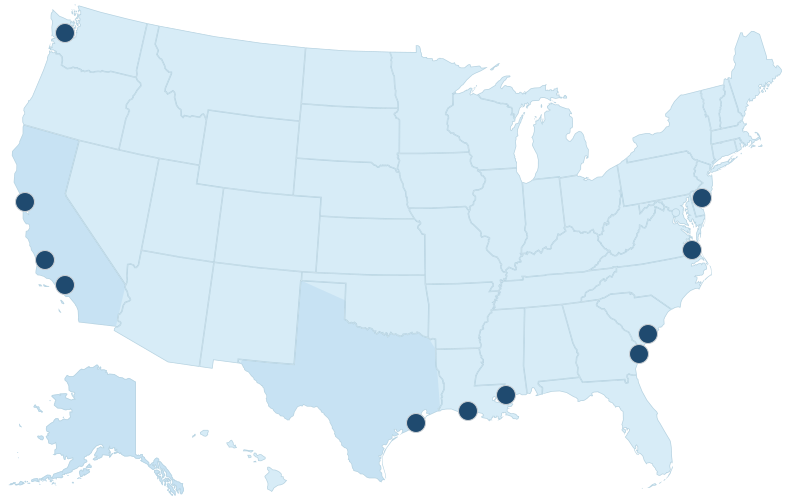
Airlift’s India-to-USA containers land mostly at New York and New Jersey, Norfolk, Savannah, Houston, Los Angeles, Charleston and Oakland. At each of these ports, and at Seattle and Tacoma, New Orleans and Mobile, drayage is arranged through contracted motor carriers, with Airlift acting as the broker. The terminals differ in their appointment systems, chassis supply and gate hours, but the release, appointment, pickup and empty-return steps are the same everywhere.
Weight rules differ by state, as the Texas port permit at Houston shows. Tell us the weight early and we check what applies on your route.
Gateways, their sailings and sample port pairs
Swipe sideways to see all columns →
Chassis, chassis splits and the equipment behind a drayage move
A chassis is the wheeled trailer frame a container rides on. Chassis come from pools and leasing companies, which keep depots near the terminals, or from the trucker’s own fleet. Whoever supplies it charges for each day the chassis is out, which is why a container left at a dock for a week also runs up a week of chassis charges.
A chassis split happens when the chassis has to be collected from, or returned to, a different place than the container. If the terminal has no chassis available, the trucker first drives to a chassis depot, then to the terminal; if the terminal won’t take the chassis back with the empty, it goes to a depot afterwards. Each split is an extra stop and an extra charge. It depends on chassis supply at the terminal on the day, so it is quoted as a possible charge, not a certainty.
Matching the equipment to the container
- Standard chassis. For 20′, 40′ and 40′ high cube containers within normal road weights. Most moves use one.
- Tri-axle chassis. A third axle spreads the weight so that each axle and axle group stays within its limit. It helps heavy 20′ containers, but it doesn’t raise the 80,000-pound gross limit on the Interstate.
- Reefer containers and gensets. A refrigerated container needs power on the road, from a genset, a portable generator attached to the container. The Port Authority of NY & NJ tells truckers to confirm genset needs with the line before dispatch; we arrange it with the trucker.
- Flatbeds, open tops and out-of-gauge. Flat racks, open tops and cargo too wide or tall for a standard container need a flatbed or specialized trailer and, where they exceed the legal dimensions, state oversize permits. Send the dimensions and weight of each piece.
Live unload, drop and pick, and pre-pull: choosing how the container is delivered
How the container is handed over at your end decides most of the chassis, detention and waiting-time charges. Tell us your dock, labor and receiving hours when you book and we’ll plan the one that costs least for your situation.
- Live unload. The driver waits while you unload, then takes the empty straight back. It uses the chassis for the fewest days and returns the empty soonest. It suits docks with labor on hand and cargo that can be unloaded in a few hours. Beyond the trucker’s free waiting time, driver waiting time is charged.
- Drop and pick. The trucker leaves the container on its chassis at your site and collects the empty later, when you call it in. It suits cargo that takes longer to unload, or sites that receive on their own schedule. You pay for an extra trip and the chassis days, and detention keeps running until the empty is returned.
- Pre-pull. The trucker collects the container from the terminal before you can receive it, stores it in its own yard and delivers it later. It is worth it when the Last Free Day is near, the terminal is congested or gates are closed on your delivery day: it trades demurrage for an extra move and yard storage.
- Delivery appointments, liftgate and residential delivery. These are extra services on the delivery leg. Mention them when you ask for a quote so they are priced in. A full container needs a site where a tractor and chassis can safely park and be unloaded. Loose cargo for a residence or a site without a dock is usually delivered from a CFS or warehouse on a smaller truck with a liftgate.
Overweight and hazmat containers
Overweight containers
On the Interstate System the maximum gross vehicle weight is 80,000 pounds, or less where the federal bridge formula requires, with 20,000 pounds on a single axle and 34,000 pounds on a tandem axle group (23 CFR 658.17). The tractor, chassis, container and cargo all count, so a container can be legal to ship by sea and still too heavy to truck.
Federal rules let states issue special permits only for nondivisible loads, which a container of cartons or stone slabs usually isn’t (23 CFR 658.5 and 658.17(h)). Some states issue their own permits for sealed ocean containers on set routes near the ports, such as New Jersey’s annual permit for ocean-borne containerized cargo and the Texas port permit near Houston. Where no permit applies, the options are a tri-axle chassis that keeps the axles legal, a route off the Interstate the state allows, or loading less at origin.
The cheapest fix is at origin. Tell us the gross cargo weight when you book the ocean freight, and we check it against the equipment and route before the container is stuffed.
Hazardous materials (hazmat) containers
A container carrying hazardous materials must show the right placards (49 CFR 172.512), and the driver needs a commercial driver’s license with a hazardous materials endorsement (49 CFR 383.93). Not every driver holds the endorsement, so hazmat drayage is arranged only with carriers qualified for it.
Send the safety data sheet, the UN number and class, and the packing group with your quote request. Terminals may also ask for hazardous cargo documentation at the gate.
After drayage: transloading, cross-docking, rail and final delivery
Drayage often isn’t the last leg. What happens next depends on where the cargo is going and how it has to arrive.
- Transloading. The container is drayed to a partner warehouse near the port, unloaded, and the goods are reloaded into 53′ domestic trailers. It suits multi-stop deliveries, retailer routing rules and inland destinations, and it frees the ocean container early, which stops detention. How it works, when it pays and what to send for a quote are on the warehousing page.
- Cross-docking. Cargo moves from the inbound container to outbound trucks with little or no time in storage, to cut dwell time. It is arranged per shipment through partner warehouses.
- Rail to inland points (IPI). On inland-point intermodal routing, the container lands at a West Coast port and continues by rail to an inland ramp such as Chicago, Dallas, Memphis or Kansas City under the same ocean bill of lading. Drayage then runs from the rail ramp to your door, with the same free-time and empty-return rules as at a port.
- LCL delivery from the CFS. Shared-container (LCL) cargo is unloaded at a container freight station after arrival, and once released it is trucked from the CFS to your door, or collected by your own carrier.
Documents and handoffs for a drayage move
A container leaves the terminal only when the right papers and releases reach the right people. These are the ones a drayage move depends on, and who they come from.
- Importer Security Filing (ISF). Filed before the cargo is loaded at origin. A late or missing ISF can lead to a hold at arrival, which stops the appointment. More →
- Arrival notice. From the carrier or NVOCC before the vessel arrives: the vessel, estimated arrival, terminal, charges due and free time.
- Freight release. From the carrier, once the freight is paid and the original bill of lading is surrendered or the bill is released. The Port Authority of NY & NJ lists it, with the container number and bill of lading number, as what a trucker needs for an import pickup.
- Customs release. CBP releases the entry filed by your customs broker. Airlift is not a customs broker; it coordinates the entry through its licensed customs-broker network, and if CBP orders an exam the container may be drayed to a Centralized Examination Station (CES) first. More →
- Delivery order. The document that authorizes the inland carrier to collect the cargo, issued by the consignee or its customs broker.
- Interchange receipt (EIR or TIR). Records the container’s and chassis’s condition and the time at each gate, out at pickup and in at empty return. It is the evidence for detention and damage claims.
- Proof of delivery (POD). Signed by your receiver at delivery, with any shortage or damage noted on it. We collect it and send it to you.
What to send for a drayage or trucking quote
Send these details through the form on this page, headed “Get a trucking quote.” The more of them you include, the fewer charges will be “to be confirmed” on the quote, and the fewer will turn up on the invoice.
- Container and bill of lading numbers. Or the booking number, if the container hasn’t sailed yet. With them we can see the vessel, the terminal and the free time.
- Port, terminal or rail ramp. Where the container will be picked up, and the vessel’s estimated arrival.
- Delivery address and receiving hours. Including whether it is a business with a dock, a site without one, or a residence, and any appointment the receiver requires.
- Container size and gross weight. 20′, 40′, 40′ high cube or reefer, and the gross cargo weight, so we can check the road limits and the chassis.
- Commodity and any hazmat. What the cargo is and, for hazardous materials, the safety data sheet, UN number and class.
- Live unload or drop. Whether you can unload while the driver waits, or need the container dropped.
- Extras at delivery. Liftgate, inside delivery, delivery appointment or residential delivery for loose cargo, and whether you need transloading or storage first.
- Customs status. Whether the entry is filed and by whom, so the pickup can be planned around the release.
The quote lists the drayage and every charge known upfront, such as fuel and port fees, and names the time-based charges (demurrage, detention, chassis, storage and waiting time) with the free time each allows. If something outside the plan comes up, we tell you and confirm the cost before it is incurred. No prices are published on this site, because they change with the port, the distance and the month.