On this page
Content reviewed September 2026. FMC OTI license 016162.
What LCL shipping is, and how consolidation works
LCL (less than container load) is ocean freight for cargo that doesn’t fill a container. Your pallets or cartons share a container with other shippers’ goods, and you pay for the space and weight you use, not for the whole box.
A consolidator makes this work. It books the container, fills it with several shippers’ cargo at origin and splits it up again at destination. Airlift USA is that consolidator: an FMC-licensed NVOCC and freight forwarder (OTI license 016162), C-TPAT certified, consolidating LCL cargo since 1999.
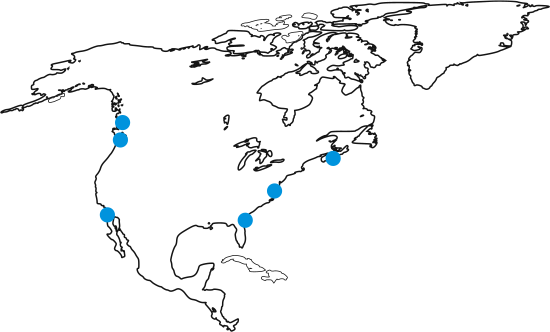
Airlift has its own offices in Los Angeles, New Jersey, Ho Chi Minh City, Dhaka and Phnom Penh, plus fourteen branches across India. LCL from any other origin is arranged through Airlift’s own offices and agent network, and US customs entries are coordinated through its licensed customs-broker network.
The consolidation cycle, step by step
- Receiving at the origin CFS. Your cargo is delivered, or collected, to a container freight station (CFS) at the origin port before the consolidation’s receiving cut-off. The CFS counts, measures and weighs each piece, and those measurements, not your packing list, set the chargeable volume.
- Consolidation under one master bill. The consolidator loads several shippers’ cargo into one container, blocked and braced, and moves the container to the terminal in time for the vessel’s cut-offs. The ocean carrier issues one master bill of lading for the whole container, to the consolidator.
- A house bill for each shipper. Airlift, as the NVOCC, issues its own house bill of lading to each shipper for that shipper’s cargo. The house bill is your contract of carriage, the document your ISF is filed against and the number you track by.
- Ocean transit. The container sails on the same vessel and service as any full container. The LCL cargo inside has no separate voyage.
- Deconsolidation at the destination CFS. At the US port, the container is trucked (drayed) to a CFS and unstuffed. Each house-bill shipment is sorted and held until customs releases it, so origin export clearance, the ISF and the entry all need to be in order for your cargo to leave without delay.
- Delivery. Once released, your cargo is trucked from the CFS to your door, or picked up by your own carrier. CFS free time is short, so file the entry before the vessel arrives.
FCL vs LCL: which should your shipment use?
The short answer: below about 13 m³, LCL is usually cheaper; above 20 m³, a container of your own usually is; in between, get both quotes. Volume decides most shipments, but handling, transit and the goods themselves count too. Published guides put the crossover between about 10 and 15 m³ (one says start comparing FCL from around 10 m³; another says LCL suits 2 to 13 m³ and a container wins from about 14 m³ or ten standard pallets). Airlift’s thresholds, used on every lane, sit inside that band, but the lane and the season shift them, so ask for both quotes near a boundary.
Swipe sideways to see all columns →
| LCL | FCL |
|---|
| Volume | Usually cheaper below about 13 m³. | Usually cheaper above 20 m³. Between 13 and 20 m³, compare both: once CFS charges are added, a 20′ container often costs little more than the same cargo as LCL. |
| What you pay for | The space and weight you use (weight or measure), plus CFS handling at both ends. | The whole container, full or not, plus terminal handling. |
| Handling | Several touches by several parties: at the origin CFS, at loading, at unstuffing and at delivery. | Loaded and sealed at the factory or origin CFS and opened at your door. No other shipper’s cargo touches it. |
| Transit | Same vessel as FCL, but door-to-door takes longer: the CFS receiving cut-off comes earlier at origin, and deconsolidation and release add days at destination. | The service’s port-to-port range. The container can be delivered as soon as it is released at the terminal. |
| Damage and mix-up risk | Higher, because of the extra handling and shared space, so packing and marking matter more. | Lower. The seal stays on from origin to door. |
| Cut-offs | CFS receiving cut-off, usually earlier than the container cut-off for the same sailing. | Document, VGM and gate-in cut-offs on the booking confirmation. |
| Typical cargo | Samples, first orders, replenishment, seasonal or irregular volumes, market tests. | Regular production volumes, dense goods that reach road weight limits, and time-critical or fragile goods even at small volumes. |
| When to use air instead | A few cartons can be cheaper by air once LCL minimums and CFS charges are counted, and air takes days rather than weeks. | Rarely. Air replaces a container only when the deadline leaves no choice. |
Shipping something dense, like tiles, stone, hardware or machinery parts? Check the weight as well as the volume. LCL is charged on whichever is greater, and a 20′ container reaches US road weight limits long before it is full.
How LCL is priced: weight or measure (W/M), plus handling at both ends
LCL ocean freight is charged on weight or measure (W/M): per cubic meter or per 1,000 kg, whichever is greater. One cubic meter and one metric ton each count as one “revenue ton.” So a 4 m³ shipment weighing 900 kg is billed as 4 revenue tons, and the same 4 m³ weighing 5,200 kg is billed as 5.2.
Most consumer goods, garments and furniture pay by volume; only cargo denser than 1,000 kg per cubic meter pays by weight. Consolidators also set a minimum, so a single small carton is charged as if it were the minimum volume.
The ocean freight line is only part of the cost. LCL carries handling charges at both ends that FCL doesn’t, so a quote showing only the per-cubic-meter freight can’t be compared with one that also shows CFS, documentation, customs and delivery. The table lists what an LCL quote to the United States normally contains and how each line is calculated. It gives no figures, because they change by origin, CFS and month.
Have carton or pallet sizes? Work out the cubic meters, weight and revenue tons before you ask for a quote. Calculate your CBM and revenue tons →
What goes into the cost of an LCL shipment
Ask for each line below to be shown separately, along with the chargeable volume the quote assumes, so you can check the invoice against the CFS receiving report.
Swipe sideways to see all columns →
| Charge | How it’s calculated | When it applies |
|---|
| Ocean freight | Per revenue ton (m³ or 1,000 kg, whichever is greater) for the port pair, subject to a minimum. | Every LCL shipment |
| Origin CFS and consolidation handling | Per revenue ton or per shipment at the origin CFS: receiving, measuring, palletizing if requested, loading. | Every LCL shipment |
| Origin documentation and export handling | Per house bill: export declaration, house bill issue, carrier documentation. | Every LCL shipment |
| Pickup at origin | Per truck or per shipment, from the factory to the CFS. | Any terms where the shipper doesn’t deliver to the CFS itself |
| Destination CFS and deconsolidation | Per revenue ton or per shipment at the US CFS: unstuffing, sorting, storage within free time, loading out. | Every LCL shipment |
| Destination documentation | Per house bill: delivery order, release, and any carrier or terminal fees passed through. | Every LCL shipment |
| Importer Security Filing | Per house bill, filed before the cargo is loaded. | Every US import by vessel |
| Customs entry and bond | Per entry, through the licensed broker network; a single-transaction bond per entry or a continuous bond for the year. | Every US import |
| Duties, MPF and HMF | By HTS code and customs value; paid to CBP, not to the forwarder. | Every US import; the tariff simulator estimates them |
| Delivery from the CFS | Per shipment by truck, based on distance and whether a liftgate or delivery appointment is needed. | Door delivery |
| Cargo insurance | On the insured value, arranged on request. | Optional, but recommended for LCL |
LCL is quoted by inquiry, normally within one business day, with every line above shown separately. The quote is built on the pieces, dimensions, weights, origin, delivery address and cargo-ready date you send. The instant rate search on this site covers carriers’ published FCL rates by equipment type only; it doesn’t price LCL.
How to get an LCL quote
Send the seven details below through the inquiry form on this page, headed “Get an LCL ocean freight quote.” Airlift’s team replies with every cost line shown separately, normally within one business day. LCL is priced on your pieces, not on a container type, so the more precisely you describe the cargo, the closer the quote will be to the invoice.
What to send
- Origin and destination. The pickup address or the origin CFS you will deliver to, the destination port or CFS, and your delivery address if you want door delivery. Say whether the supplier delivers to the CFS or needs collection.
- Pieces, dimensions and gross weights. How many pallets or cartons, and the outer dimensions and gross weight of each, measured after wrapping and including the pallet. The quote uses your figures; the invoice uses what the CFS measures.
- Commodity, HTS code and value. What the goods are, the HTS code if you know it and the invoice value, so duties, MPF and HMF can be estimated and any agency requirement flagged.
- Dangerous goods, temperature or oversize. Tell us at inquiry, with the safety data sheet for hazardous cargo. It decides whether the cargo can go in a consolidation at all.
- Incoterms and scope. EXW, FOB or another term, and whether you want port-to-port, CFS-to-door or door-to-door, so every quote you compare covers the same legs.
- Cargo-ready date. When the goods can be at the CFS. It sets which consolidation closing and which sailing the quote is built on.
- Importer details for the ISF and entry. Importer of record, consignee number, bond status (continuous or single-transaction), and whether Airlift’s licensed broker network or your own broker files the entry.
What the quote includes
- The chargeable volume in revenue tons, and the ocean freight per revenue ton with its minimum.
- Origin CFS and consolidation handling, origin documentation, and pickup if you asked for it.
- Destination CFS and deconsolidation, destination documentation, the ISF, the entry and bond, and delivery if you asked for it.
- The consolidation’s receiving cut-off, the sailing it is booked on, the port-to-port planning range and the expected deconsolidation date.
- An estimate of duties, MPF and HMF by HTS code. These are paid to CBP, not to the forwarder.
The rate search on this site returns carriers’ published ocean rates for full containers (availability varies) and has no LCL mode, which is why LCL is priced by enquiry. Want your revenue tons before you ask? The chargeable weight calculator works them out from your dimensions.
Consolidation schedules and CFS cut-offs
Each consolidation is booked on one sailing. It closes once the cargo for that sailing has been received, loaded into the container and gated in before the carrier’s cut-offs. Airlift runs consolidations regularly on its supported lanes, but how often a given port pair closes depends on cargo flow. Don’t assume a weekly cycle: ask which closing and which vessel your cargo is booked on. The sailing schedules themselves (carriers, services, vessels and transit days by port pair) are published on Airlift Sealanes.
The consolidator has to receive, measure, load, weigh and seal the container before it can gate in, so the CFS receiving cut-off comes before the container cut-off for the same vessel. Miss it and your cargo waits for the next closing, not the next day.
The cut-offs on every LCL booking
- CFS receiving cut-off. The last day the origin CFS accepts cargo for that consolidation. The cargo must be physically at the CFS, counted and measured, not still on a truck.
- Documentation cut-off. The deadline for the house-bill shipping instructions, the commercial invoice and packing list, and the export declaration data, so the consolidator can send the carrier its shipping instructions for the master bill in time.
- Verified gross mass (VGM). Under SOLAS regulation VI/2, in force since July 1, 2016, the shipper named on the carrier’s bill of lading is responsible for the verified gross mass of the packed container. One of the two permitted methods is to weigh every package, pallet and piece of dunnage and add the container’s tare weight. In a consolidation that shipper is the consolidator, which is why every LCL shipper must give an accurate gross weight per piece by the documentation cut-off.
- ISF. The importer’s ten data elements are filed against the house bill no later than 24 hours before the cargo is loaded onto the vessel at the foreign port (19 CFR 149.2). In practice, Airlift needs them by the documentation cut-off.
- Container cut-off. The carrier’s document, VGM and gate-in cut-offs for the consolidated container on the master bill. The consolidator manages them, and they are the reason the CFS receiving cut-off is earlier.
At destination: CFS free time and the general-order clock
At the US port, the container is drayed to a container freight station and unstuffed. A CFS operates under its own CBP bond, independently of the importing carrier (19 CFR 19.40). Each house-bill shipment is released once its entry is accepted. The CFS allows a short free period; after that, storage charges accrue daily.
There is also a regulatory clock. Merchandise landed without a release permit may stay at the place of unlading only until the fifteenth calendar day after landing (19 CFR 4.37). After that it can be sent to a general-order warehouse, at the importer’s cost. Filing the entry before the vessel arrives keeps an LCL shipment clear of both the storage charges and the clock.
LCL transit time: the same vessel, plus the CFS days
On the water, LCL takes exactly as long as FCL on the same service, because the consolidated container sails as one box. What makes LCL slower door-to-door is what happens on either side of the voyage.
At origin, the CFS receiving cut-off comes before the container cut-off, so your cargo has to reach the CFS earlier than a full container would gate in. At destination, the container has to be drayed to the CFS and unstuffed, and each shipment sorted, before it can be released, which takes days rather than hours. Add both to the port-to-port range when you plan.
The port-to-port ranges below are the ones Airlift’s lane guides publish from shipment history (P10 to P90, meaning most shipments fall inside them). They are planning ranges for the ocean leg, not guaranteed schedules and not LCL door-to-door times. Ask for the consolidation’s receiving cut-off and expected deconsolidation date with your quote.
Port-to-port planning ranges on the main LCL lanes
Swipe sideways to see all columns →
- Consolidation frequency. A consolidation closes when it has enough cargo for the sailing. On high-volume port pairs that happens regularly; on thinner lanes, cargo may wait for the next closing. Ask which sailing your cargo is booked on, not just the transit time.
- Routing. Direct services sit at the short end of the range. Relays through a hub such as Singapore, Port Klang or Colombo add connection time, and are common for LCL from secondary ports.
- Release at destination. The ISF, the entry and any agency hold decide how quickly cargo leaves the destination CFS after unstuffing. Filing the entry before arrival is the single biggest time saver for LCL door-to-door.
- CFS free time. Destination CFS storage is free only for a short period after the cargo is available, then charges accrue daily. Arrange delivery as soon as you expect release.
LCL from India and Asia to the USA
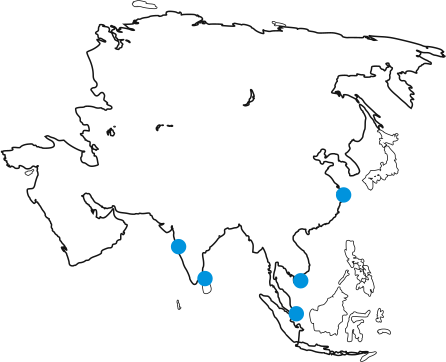
Most LCL into the United States starts in India, China or Southeast Asia. At origin, your cartons or pallets are delivered to a container freight station (CFS) near the port, measured and weighed, and loaded with other shippers’ cargo into a container bound for the same US gateway. The container moves under the carrier’s master bill; your cargo moves under Airlift’s house bill.
At the US end the container is trucked to a CFS near Los Angeles/Long Beach, New York/New Jersey or Savannah, unstuffed and sorted, and each shipment is released once its customs entry clears. Inland destinations are delivered by truck from that CFS.
Door to door, LCL from Asia typically takes longer than FCL on the same lane: the ocean leg is the same vessel, but the origin CFS cut-off comes earlier and deconsolidation adds days at destination. The per-origin blocks below give the lane guides’ port-to-port ranges; add the CFS days at both ends.
Airlift consolidates LCL cargo from any origin through its own offices and agent network. Its own offices handle the origin side in India (fourteen branches), Vietnam (Ho Chi Minh City), Bangladesh (Dhaka) and Cambodia (Phnom Penh). China, Thailand, Indonesia and other origins are handled through the partner network, under Airlift’s house bill. Each lane guide below has an FCL and LCL section with the same thresholds as this page, plus port-pair transit ranges for that corridor. The Sealanes pages show which carriers sail each port pair, how often, and how long it takes.
Swipe sideways to see all columns →
| Lane | Origin gateways | Port pages | Lane guide |
|---|
| India to USA | Nhava Sheva, Mundra, Chennai, Tuticorin | Nhava Sheva, Mundra, Chennai | FCL & LCL section |
| China to USA | Shanghai, Ningbo, Shenzhen (Yantian, Shekou), Qingdao | Shanghai, Ningbo, Shenzhen, Yantian | FCL & LCL section |
| Vietnam to USA | Ho Chi Minh City (Cat Lai), Hai Phong | Ho Chi Minh City, Hai Phong | FCL & LCL section |
| Bangladesh to USA | Chittagong (Chattogram) | Chittagong | FCL & LCL section |
| Cambodia to USA | Phnom Penh, Sihanoukville | Phnom Penh, Sihanoukville | FCL & LCL section |
| Thailand to USA | Laem Chabang, Bangkok | Laem Chabang, Bangkok | FCL & LCL section |
| Indonesia to USA | Jakarta (Tanjung Priok), Surabaya | Jakarta, Surabaya | FCL & LCL section |
| India to Canada | Nhava Sheva, Mundra, Chennai | Montreal, Vancouver | FCL & LCL section |
| India to Mexico | Mundra, Nhava Sheva | Altamira, Veracruz, Manzanillo | FCL & LCL section |
LCL from each origin
LCL from India to the USA
Airlift’s own offices, fourteen Indian branches, handle the origin side. Cargo is received at a CFS serving Nhava Sheva (JNPT), Mundra or Chennai, consolidated under Airlift’s house bill, and deconsolidated at a CFS near New York/New Jersey, Los Angeles or Long Beach. Port-to-port planning ranges from the lane guide: 32–40 days Nhava Sheva to New York and 37–54 days Chennai to Los Angeles, plus the CFS days at each end.
LCL from China to the USA
Consolidations from Shanghai, Ningbo and Shenzhen (Yantian and Shekou) are arranged through Airlift’s partner network at the origin CFS. They move under Airlift’s house bill to a CFS near Los Angeles/Long Beach or New York/New Jersey. Planning ranges from the lane guide: 12–22 days Shanghai to Los Angeles and 32–45 days Shanghai to New York. The guide’s customs section covers the Section 301 and Section 232 duties a Chinese-origin entry can carry.
LCL from Vietnam to the USA
Airlift’s own Ho Chi Minh City office handles the origin side. Cargo is received at a CFS in Ho Chi Minh City (Cat Lai) for the south or Hai Phong for the north. Planning ranges from the lane guide: 28–34 days Ho Chi Minh to Los Angeles and 35–45 days to New York, including feeder and transshipment legs through Singapore or Port Klang where the carrier’s schedule uses them.
LCL from Bangladesh to the USA
Airlift’s own Dhaka office handles the origin side. Cargo is received and consolidated at a CFS at Chittagong (Chattogram), the container gateway on this lane. Planning ranges from the lane guide: 45–54 days Chittagong to New York and 47–57 days to Los Angeles, which may include transshipment through Colombo, Singapore or Port Klang, depending on the carrier’s routing.
LCL from Cambodia to the USA
Airlift’s own Phnom Penh office handles the origin side. Cargo leaves through Phnom Penh, a river port close to the garment and furniture factories around the capital, or through Sihanoukville, the deep-sea port, and joins a transpacific service at a hub such as Singapore or Port Klang. Planning ranges from the lane guide: 24–34 days Phnom Penh to Los Angeles and 38–48 days to New York.
LCL from Thailand to the USA
Consolidations from the Bangkok and Laem Chabang area are arranged through Airlift’s partner network. Laem Chabang is the deep-sea gateway. Bangkok Port is a river port served by feeder and regional services, so a consolidation gated in there is relayed to a hub before it joins a transpacific ship. Planning ranges from the lane guide, transshipment included: 28–34 days Laem Chabang to Los Angeles and 36–45 days to New York.
LCL from Indonesia to the USA
Consolidations from Jakarta (Tanjung Priok) and Surabaya are arranged through Airlift’s partner network and relayed through Singapore or Port Klang. Planning ranges from the lane guide: 30–36 days Jakarta to Los Angeles and 38–48 days to New York.
US destination gateways
Consolidations from Asia are deconsolidated at CFS facilities near the main gateways: Los Angeles and Long Beach on the West Coast, and New York/New Jersey and Savannah on the East Coast. Inland destinations are served by truck from the nearest gateway CFS.
Packing for LCL, and what can’t go LCL
LCL cargo is handled several times, by several parties, and shares a container with goods it has never met, so your packing has to do more work than in a sealed container. The CFS also measures exactly what it receives: loose cartons that could have been palletized are charged at their stacked volume and travel with more risk.
- Palletize. Put cartons on pallets sized to stack, strap and stretch-wrap them, and keep the load inside the pallet footprint so nothing overhangs. A wrapped pallet is measured once and moved by forklift; loose cartons are counted and moved by hand.
- Mark every piece. Put the consignee, purchase order, carton number (e.g., 3 of 40), gross weight and dimensions on at least two sides, matching the packing list. A CFS sorts mixed cargo by its marks, and unmarked cartons are the ones that go missing.
- Wood packaging: ISPM 15. Solid-wood pallets, crates and dunnage must be heat-treated or fumigated and carry the IPPC mark (HT or MB) under 7 CFR 319.40-3. Untreated or unmarked wood can be ordered re-exported at the US port, and the whole shipment can be held while that is sorted out. Plywood, OSB, particle board and plastic pallets are not regulated wood packaging.
- Weigh and measure before booking. Your quote is based on the dimensions and weights you give; the invoice is based on what the CFS measures. Measure the outside of each pallet or carton after wrapping, including the pallet, and give gross weights.
- Dangerous goods. Hazardous cargo can move LCL only when the IMDG Code allows it to share a container with the rest of the consolidation, which depends on its class, UN number and segregation rules. Many consolidations don’t accept dangerous goods at all, and some classes are never co-loaded. Declare it at inquiry, with the safety data sheet, so we quote the right option: a dedicated container, a DG consolidation or air.
- Temperature-controlled and out-of-gauge cargo. Refrigerated and frozen goods need a reefer container of their own, because standard LCL consolidations use dry containers. Pieces too tall, wide or heavy to handle on a pallet at a CFS are quoted as FCL in open-top or flat-rack equipment.
- Insurance. Under the US Carriage of Goods by Sea Act, an ocean carrier’s liability for lost or damaged cargo is limited by law to $500 per package unless a higher value is declared on the bill of lading, and NVOCC house bills carry similar limits. All-risk cargo insurance on the invoice value is the usual answer for LCL, since the extra handling is exactly where losses happen. Airlift arranges it through insurers on request.
Documents and US customs for LCL imports
An LCL shipment clears US customs exactly like a full container: the ISF, entry, bond and duties apply per shipment and per house bill, not per container. The difference is timing. Everything has to be in place before the container is unstuffed, or your cargo waits at the CFS while the other shippers’ goods leave.
- Commercial invoice and packing list. The invoice states the value and terms of sale; the packing list itemizes every package with its marks, contents, weight and dimensions. The two must agree with each other and with the house bill, because customs compares them and the CFS sorts by marks.
- House bill of lading. Airlift issues the house bill for your cargo; the carrier’s master bill covers the whole container and you never see it. The house bill number is the one on your ISF, the one you track by, and the one surrendered (or released by telex or express release) to collect the cargo.
- Importer Security Filing (ISF 10+2). Required for every US import by vessel. It is filed at the lowest bill-of-lading level (for LCL, the house bill) no later than 24 hours before the cargo is loaded onto the vessel at the foreign port (19 CFR 149.2 and 149.3). The ten importer elements are the seller, buyer, importer of record, consignee number, manufacturer, ship-to party, country of origin, HTSUS number, container stuffing location and consolidator. Airlift files the ISF for its LCL shipments against the house bill.
- Customs entry and bond. The entry is filed through Airlift’s licensed customs-broker network, on either a continuous bond (covering a year of entries and ISF filings) or a single-transaction bond for one entry. Filing before arrival means the release can reach the CFS as the container is unstuffed.
- Duties, MPF and HMF. Duty depends on the HTS code and customs value, plus any Section 301, Section 232, antidumping or countervailing duty the origin and product carry. The merchandise processing fee (MPF) and harbor maintenance fee (HMF) apply to the entry. The tariff simulator estimates all of them for your HTS code, and the tariff-updates tracker lists the measures in force.
- Agency requirements. FDA prior notice for food, FCC rules for radio devices, CPSC certificates for children’s products and Lacey Act declarations for wood products apply to every shipment, however small the LCL lot.
- Canada: eManifest, not ISF. For LCL into Canada on the India-to-Canada lane, the US ISF doesn’t apply. Instead, the CBSA’s Advance Commercial Information (eManifest) rules require the carrier’s cargo and conveyance data and, for consolidated cargo, the freight forwarder’s house-bill data to be sent before loading: 24 hours before loading at the foreign port for marine cargo (CBSA Memorandum D3-3-1). The importer needs its own CARM registration and financial security, and the entry is filed by a licensed Canadian customs broker.