On this page
Content reviewed September 2026. FMC OTI license 016162.
What FCL shipping is, and who does what
FCL (full container load) means you book a whole container for your cargo alone. You pay for the box, not for the space your goods take up, and nothing else travels in it: the container is loaded and sealed at origin and the seal is next broken at your door or your warehouse, unless customs or another agency inspects it on the way.
Three parties make an FCL move work. The ocean carrier owns or operates the vessel and the container. The terminals load and discharge it. The forwarder or NVOCC books the space, arranges trucking and paperwork at both ends, and is your single point of contact. Airlift USA is that NVOCC and ocean freight forwarder: FMC-licensed (OTI license 016162), C-TPAT certified and shipping containers since 1999. Airlift doesn’t own ships, trucks or warehouses; it contracts space with the ocean carriers and arranges trucking, customs and storage through its own offices and partners.
Airlift has its own offices in Los Angeles and New Jersey, fourteen branches across India, and offices in Ho Chi Minh City, Dhaka and Phnom Penh. Most of its FCL runs from India to the United States. US customs entries are filed through Airlift’s licensed customs-broker network; Airlift itself doesn’t hold a US customs broker license.
House bill and master bill: the two bills of lading on an NVOCC shipment
When you ship through an NVOCC, there are two bills of lading for the same container. The ocean carrier issues a master bill of lading to the NVOCC. The NVOCC issues its own house bill of lading to you, the shipper. Airlift, as the NVOCC, issues the house bill under its FMC tariff and NVOCC bond.
The house bill is your contract of carriage and, when issued as a negotiable (to-order) bill, the document of title to the goods. It is the bill your ISF is filed against, the one you track by, and the one surrendered, or released by telex or express release, before the container is released at destination. The master bill stays between Airlift and the carrier.
FCL vs LCL: when a container of your own pays off
On volume alone: below about 13 m³, LCL is usually cheaper; above 20 m³, a container of your own usually is; in between, get both quotes. These are the same thresholds Airlift’s lane guides and LCL page use. Volume isn’t the only test, though. FCL can be the right choice well below 20 m³ when:
- The cargo is heavy. LCL is charged on weight or measure, whichever is greater, so dense goods pay by the ton. A 20′ container of stone or castings may be only half full by volume and still at its road weight limit.
- The goods are fragile or high-value. An FCL container is loaded once and opened once. LCL cargo is handled at a CFS at each end and shares the box with other shippers’ goods.
- Time matters door to door. The ocean leg is the same vessel either way, but a full container skips the CFS receiving cut-off at origin and the deconsolidation days at destination. It can be delivered as soon as it is released at the terminal.
- You want control of the schedule. An FCL booking is tied to your cargo-ready date and your vessel. An LCL shipment waits for the consolidation that closes on its port pair.
LCL still wins for a few pallets, samples, first orders and irregular volumes. The LCL page explains how consolidation, W/M pricing and CFS charges work, so you can compare the two quotes line by line.
Container types and sizes for FCL
Most FCL moves in one of four dry containers. The volumes and payloads below are the ones the container dimensions page publishes; the exact figures for any unit are on its CSC safety-approval plate and vary by build and carrier. Plan to use roughly 80–85% of the cube once pallets, dunnage and packaging are in.
Swipe sideways to see all columns →
| Container | Internal volume | Max payload | Best for |
|---|
| 20′ standard | about 33.2 m³ | 28,230 kg | Dense, heavy cargo: stone, tiles, metal castings, machinery parts, bagged goods. Usually reaches its weight limit before it is full. |
| 40′ standard | about 67.7 m³ | 26,730 kg | General cargo that is heavier than it is bulky, or that needs twice the floor of a 20′ without the extra height. |
| 40′ high cube | about 76.3 m³ | 26,540 kg | Light, bulky cargo: furniture, garments, home textiles, cartoned consumer goods. The extra height often fits one more tier of cartons. |
| 45′ high cube | about 86 m³ | 27,700 kg | Very light, bulky cargo that overflows a 40′ high cube. Offered on fewer services and some inland routings restrict it, so check it at quote. |
Payload is the container’s maximum gross weight less its tare. It is not what you can put on a US road (see below).
Road weight, not the container, is usually the limit
On the US Interstate System, a truck’s overall gross weight may not exceed 80,000 lb, enforcement tolerances included (23 U.S.C. 127). The tractor, the chassis and the empty container all count toward that figure, so the cargo you can legally truck from a US port in a standard move is well below the container’s rated payload. Dense cargo, such as granite, quartz, tiles, cast iron or steel, reaches the road limit long before it fills even a 20′ box.
Tell us the gross weight at quote. It decides the container size, whether the load needs a tri-axle chassis or an overweight arrangement at destination, and sometimes whether the cargo should be split across two containers.
Special equipment
Airlift arranges the following on request, where a carrier offers the equipment on your lane and accepts the cargo. Tell us at quote, because special equipment is scarcer than dry boxes and is confirmed per booking.
- Reefer (refrigerated). Temperature-controlled 20′ and 40′ high-cube containers for chilled and frozen goods. You give the set temperature and ventilation on the booking, and the container is plugged in at the terminal and on board.
- Open top. A removable tarpaulin roof so tall cargo or machinery can be crane-loaded from above. The cargo still has to fit within the container’s width.
- Flat rack. End walls and no sides or roof, for cargo too wide or too tall for a closed box, such as machinery, vehicles or steel structures. Out-of-gauge cargo needs the carrier’s approval and lashing plan before the booking is confirmed.
- Hazardous cargo. Dangerous goods move FCL when the carrier accepts that class and UN number on the service. They are packed, marked, labeled and declared under the IMDG Code (see documents below).
What goes into an FCL quote
FCL is priced per container, by container type, for a port pair and a sailing window. But the ocean freight is only one line. A door-to-door FCL quote to the United States is built from the charges below, and two quotes can only be compared when they cover the same legs and state the same surcharges as included or extra.
This page gives no figures. Rates and surcharges change with the carrier, the lane, the season and fuel prices, so any number printed here would be out of date. The table explains what each line is and when it applies.
The lines on a door-to-door FCL quote
Swipe sideways to see all columns →
| Charge | What it is and how it’s charged | When it applies |
|---|
| Ocean freight | Per container, by type (20′, 40′, 40′ HC), for the port pair. | Every FCL shipment |
| Bunker adjustment factor (BAF) | Fuel surcharge per container. Carriers adjust it periodically with fuel prices; sometimes it is folded into an “all-in” ocean rate. | Most carriers and lanes |
| Peak season surcharge (PSS) | Per container, added by carriers in periods of high demand. | When the carrier has one in force for the sailing |
| General rate increase (GRI) | A lane-wide increase to the base rate announced by the carrier. A quote should say whether it is valid through a date or subject to GRIs. | When announced for your sailing date |
| Origin terminal handling (THC) | Per container, for handling at the loading terminal. | Depends on terms of sale; often paid by the exporter on FOB terms |
| Origin trucking and stuffing | Per container: empty to the factory and full to the port, or cargo delivered to a CFS and loaded there. | EXW and other terms where the buyer arranges origin |
| Export documentation and customs | Per shipment: the export declaration (in India, the shipping bill), house bill of lading issue, VGM and seal. | Every export; paid by whichever party the terms of sale say |
| Destination terminal handling (DTHC) | Per container, for discharge and handling at the US terminal. Sometimes included in the ocean rate. | Every import; check whether it is in the ocean line |
| Destination documentation and release | Per house bill: delivery order, release, and carrier or terminal fees passed through. | Every import |
| Importer Security Filing (ISF) | Per house bill, filed before the container is loaded at origin. | Every US import by vessel |
| Customs entry and bond | Per entry through the licensed broker network, on a continuous or single-transaction bond. | Every US import |
| Duties, MPF and HMF | By HTS code and customs value; paid to CBP, not to the forwarder. | Every US import; the tariff simulator estimates them |
| Drayage and delivery | Per container from the port or rail ramp to your door and the empty back, plus chassis days and any fuel surcharge; pre-pull, storage or waiting time if needed. | Door delivery |
| Cargo insurance | On the insured value, arranged on request. | Optional |
Two things are not on a quote because they depend on what happens after arrival: demurrage and detention (if the container overstays its free time) and exam fees (if CBP or another agency inspects the container). The next sections explain how to keep both small.
How to get an FCL quote
Send the details below through the inquiry form on this page, headed “Get an FCL ocean freight quote.” Airlift’s team replies with each cost line shown separately and the sailing it is based on. The more precisely you describe the cargo and the scope, the closer the quote will be to the invoice.
What to send
- Origin and destination. The factory or pickup address (or origin port), the destination port, and your delivery address and whether it has a dock, if you want door delivery.
- Container type and count. For example, two 40′ high cubes a month. If you’re not sure, send the volume and weight and we’ll suggest the equipment.
- Commodity, gross weight and HTS code. What the goods are, the gross weight per container, the HTS code if you know it and the invoice value, so the equipment, road weight, duties and any agency requirement can be checked.
- Hazardous, temperature-controlled or out-of-gauge cargo. Tell us at inquiry, with the safety data sheet for dangerous goods or the dimensions of oversize pieces. It decides which carriers and equipment can take it.
- Incoterms and scope. EXW, FOB, CIF or another term, and whether you want port-to-port, port-to-door or door-to-door, so every quote you compare covers the same legs.
- Cargo-ready date. When the container can be loaded. It sets the sailing, the cut-offs and the rate validity the quote is built on.
- Importer details for the ISF and entry. Importer of record, bond status (continuous or single-transaction), and whether Airlift’s licensed broker network or your own broker files the entry.
Want a starting point first? The rate search on this site returns carriers’ published FCL rates by equipment type where they are available. It shows ocean freight only, not the full door-to-door cost above.
FCL from booking to delivery, step by step
Here is how an import FCL shipment runs, using India to the United States as the example. The dates that matter (cut-offs, free time, last free day) are on your booking confirmation and arrival notice; everything else follows from them.
- Booking and space. Airlift books the container with a carrier on a named vessel and voyage and sends a booking confirmation with the equipment, the sailing and the cut-off dates.
- Empty pickup. Under the carrier’s release, a trucker collects an empty container of the booked type from the carrier’s depot. Check it on arrival: clean, dry, no holes, doors that seal.
- Stuffing. The container is loaded either at your factory (factory stuffing), where you load, block and brace it, or at a container freight station or inland depot, where the goods arrive loose and are loaded there. Either way the container is sealed with a numbered seal, and the seal number goes on the bill of lading.
- Export customs. The export declaration is filed at origin (in India, the shipping bill through ICEGATE, with the commercial invoice and packing list) and customs lets the goods out for export.
- VGM. Before the carrier will load it, the container needs a verified gross mass under SOLAS regulation VI/2: either the packed container is weighed, or every package, pallet and piece of dunnage and securing material is weighed and the container’s tare added. It is sent to the carrier by the VGM cut-off.
- Shipping instructions and ISF. The shipper sends the shipping instructions (the data that goes on the bill of lading) by the documentation or SI cut-off. For US imports, the ISF is filed no later than 24 hours before the container is loaded on the vessel (19 CFR 149.2).
- Gate-in by the CY cut-off. The full container must be in the terminal (the container yard, or CY) by the port cut-off for the vessel. Miss it and the container rolls to the next sailing.
- Sailing and bills of lading. After the vessel sails, the carrier issues the master bill to Airlift and Airlift issues your house bill. You choose an original bill, a telex release or an express (sea waybill) release when booking.
- Transshipment. Some services sail direct to the United States; others relay the container through a hub port, which adds connection time and some risk of rolling to a later vessel. Your quote names the routing.
- Arrival and discharge. An arrival notice goes out before the vessel arrives. After discharge, the container is available once the terminal releases it; free time usually starts at discharge.
- Customs and freight release. Two releases are needed. CBP releases the goods once the entry is accepted, which is why the entry should be filed before arrival. The carrier and NVOCC release the container once freight is paid and the house bill is surrendered or released.
- Drayage and delivery. A drayage carrier picks the container up from the terminal or rail ramp and delivers it to your door. You unload it while the driver waits (live unload), or the container is dropped and collected later.
- Empty return. The empty goes back to the terminal or depot the carrier names. Detention, the charge for keeping the carrier’s container, runs until it is returned.
The cut-offs on every FCL booking
- SI / documentation cut-off. The last time to send the shipping instructions for the bill of lading. Late SI can mean the container isn’t manifested and misses the vessel.
- VGM cut-off. The last time the carrier accepts the verified gross mass for loading.
- CY / port cut-off. The last time the full container can gate into the terminal for that vessel.
- ISF. No later than 24 hours before loading at the foreign port. The container stuffing location and consolidator may follow, but no later than 24 hours before arrival at a US port (19 CFR 149.2).
Free time, demurrage and detention, and how to avoid them
Every import container comes with a number of free days. Free time is set by the carrier’s tariff or your service contract and varies by carrier, port and terminal, so ask for it with the quote and check it on the arrival notice. The last day before charges start is the last free day.
The FMC’s rule on demurrage and detention billing (46 CFR part 541) treats them as charges, including “per diem,” for the use of marine terminal space or shipping containers, not freight. In practice: demurrage is charged while the loaded container stays in the terminal past its free time; detention (or per diem) is charged while the carrier’s container is outside the terminal past its free time, at your door or on the road, until the empty is returned. Storage at a warehouse or depot is a separate charge again.
What the FMC billing rule requires
- Invoice within 30 days. A carrier or terminal must issue a demurrage or detention invoice within 30 calendar days of the last day the charge was incurred; an NVOCC passing the charge on has 30 days from the invoice it received. A late invoice doesn’t have to be paid (46 CFR 541.7).
- Required contents. The invoice must show, among other things, the bill of lading and container numbers, the free time and its start and end dates, the container availability date, the dates charged, the rate and the tariff or contract rule behind it, and how to dispute it (46 CFR 541.6). If required information is missing, the charge isn’t owed (46 CFR 541.5).
- Disputes. The billed party gets at least 30 calendar days from the invoice to ask for mitigation, refund or waiver, and the billing party must try to resolve the request within 30 days (46 CFR 541.8).
How to keep a container inside its free time
- File the ISF and entry early. Have the entry filed before the vessel arrives so customs release doesn’t eat into free time.
- Book drayage against the ETA. Line up the trucker before arrival, not after the discharge notice. At busy ports, pickup appointments can be days out.
- Settle the release in advance. Pay freight and surrender or release the bill of lading before arrival, so the container isn’t held for paperwork.
- Plan the unload. A dropped container accrues detention while it waits to be unloaded. Have labor and a dock ready, and return the empty promptly.
- Watch the container, not the vessel. Discharge can come days after the vessel arrives, and transshipment delays move the dates. Track the container number.
- Check every invoice. Compare demurrage and detention invoices against the part 541 list above before paying.
There is also a customs clock. Cargo landed without a release may stay at the place of unlading only until the fifteenth calendar day after landing (19 CFR 4.37). After that it can be moved to a general-order warehouse, at the consignee’s risk and expense.
FCL transit time from India and Asia to the USA
The ranges below are the port-to-port planning ranges Airlift’s lane guides publish from its own shipment history (P10 to P90, meaning most shipments fall inside them). They are not guaranteed schedules. Door to door, add the days before sailing (empty pickup, stuffing, export customs, gate-in before the cut-off) and after arrival (discharge, release, drayage).
India to the US East and Gulf Coasts is the long leg; the West Coast from China and Vietnam is the short one. Each port pair has its own page with the range, the carriers that sail it and the ports at each end.
Port-to-port planning ranges on Airlift’s main FCL lanes
Swipe sideways to see all columns →
- Routing. Direct services sit at the short end of a range; services that relay through a hub port add connection time.
- Rolled bookings. In busy periods, carriers can roll a container to a later vessel. Book early and have documents in before the cut-offs.
- Port congestion. Berthing and discharge delays at either end push out the arrival date, and can shift the free time.
- Release and pickup. Customs release, freight release and a drayage appointment decide how fast the container leaves the terminal after discharge.
FCL lanes and ports: India to the USA first
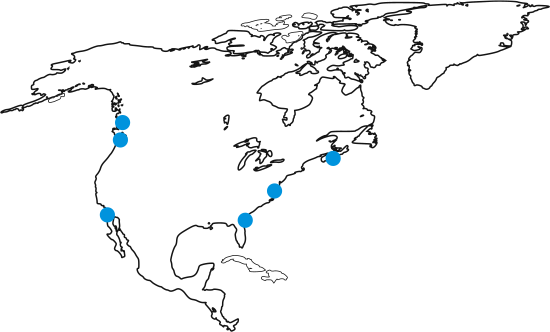
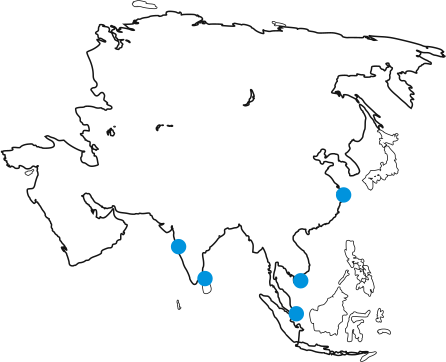
Most of Airlift’s FCL moves from India to the United States. On the Indian side, the main load ports are Mundra and Nhava Sheva (JNPT) on the west coast and Chennai and Ennore on the east, with Airlift’s own branches handling bookings and export paperwork. On the US side, most containers discharge at the East and Gulf Coast gateways, such as New York/New Jersey, Norfolk, Savannah, Charleston and Houston, with the West Coast (Los Angeles/Long Beach and Oakland) serving the western states and some inland points.
Airlift also ships FCL from China, Vietnam, Bangladesh, Cambodia, Thailand and Indonesia to the USA, and from India to Canada and Mexico. The Vietnam, Bangladesh and Cambodia origins are handled by Airlift’s own offices there; China, Thailand, Indonesia and other origins through its partner network, under Airlift’s house bill.
India to USA: ports, routes and sailings
Other FCL lanes
Swipe sideways to see all columns →
| Lane | Main origin ports | Lane guide |
|---|
| India to USA | Mundra, Nhava Sheva, Chennai, Ennore, Kolkata, Pipavav | India to USA guide |
| China to USA | Shanghai, Ningbo, Shenzhen | China to USA guide |
| Vietnam to USA | Ho Chi Minh City, Hai Phong | Vietnam to USA guide |
| Bangladesh to USA | Chittagong (Chattogram) | Bangladesh to USA guide |
| Cambodia to USA | Phnom Penh, Sihanoukville | Cambodia to USA guide |
| Thailand to USA | Laem Chabang, Bangkok | Thailand to USA guide |
| Indonesia to USA | Jakarta, Surabaya | Indonesia to USA guide |
| India to Canada | Nhava Sheva, Mundra, Chennai | India to Canada guide |
| India to Mexico | Mundra, Nhava Sheva | India to Mexico guide |
Documents and US customs for FCL imports
A full container clears US customs on the same rules as any other ocean shipment. What changes with FCL is scale: one wrong HTS code or one unmarked pallet can hold a whole container, and demurrage keeps running while it waits.
- Commercial invoice and packing list. The invoice states the seller, buyer, value, currency and terms of sale; the packing list gives each package’s marks, contents, weights and dimensions. They must agree with each other and with the bill of lading.
- Bill of lading. Airlift’s house bill for your container, issued after sailing. An FCL bill normally carries a “shipper’s load, stow and count” clause, because the carrier never sees inside the sealed container.
- Importer Security Filing (ISF 10+2). Required for every shipment arriving in the United States by vessel, filed at the lowest bill-of-lading level (the house bill) no later than 24 hours before loading at the foreign port (19 CFR 149.2 and 149.3). The ISF Importer, the party causing the goods to arrive, is responsible for it and may file through an agent (19 CFR 149.1). Airlift files the ISF itself, as the NVOCC, for the ocean shipments it books. CBP can claim liquidated damages of $5,000 per violation against the bond (19 CFR 113.62(j)).
- Customs entry and bond. The entry is filed through Airlift’s licensed customs-broker network on either a continuous bond (a year of entries and ISFs) or a single-transaction bond. Filing before arrival lets the release come through as the container is discharged.
- Duties, MPF and HMF. Duty depends on the HTS code, the customs value and the country of origin, plus any Section 301, Section 232, antidumping or countervailing duty. The merchandise processing fee and harbor maintenance fee apply to the entry. The tariff simulator estimates them for your HTS code.
- Wood packaging: ISPM 15. Solid-wood pallets, crates, skids and dunnage must be heat-treated or fumigated and carry the IPPC mark (HT or MB) under 7 CFR 319.40-3. Unmarked wood packaging can be ordered re-exported, and in a sealed FCL container that can mean the whole load. Plywood, OSB, pressboard and plastic pallets are not regulated wood packaging.
- Hazardous materials. Dangerous goods by sea are governed by the IMDG Code, mandatory under SOLAS chapter VII. US rules allow shipments moving by vessel to, from or within the United States, and the connecting truck, to be offered under the IMDG Code (49 CFR 171.25), with the truck placarded. Declare the UN number, class and packing group at booking, with the safety data sheet.
- Agency requirements. FDA prior notice for food, FCC rules for radio devices, CPSC certificates for children’s products and Lacey Act declarations for plant and wood products apply by commodity, whatever the container size.
- Cargo insurance. Under the US Carriage of Goods by Sea Act, a carrier’s liability is limited to $500 per package, or per customary freight unit for goods not shipped in packages, unless a higher value is declared and inserted in the bill of lading. All-risk cargo insurance on the invoice value is the usual protection. Airlift arranges it through insurers on request.