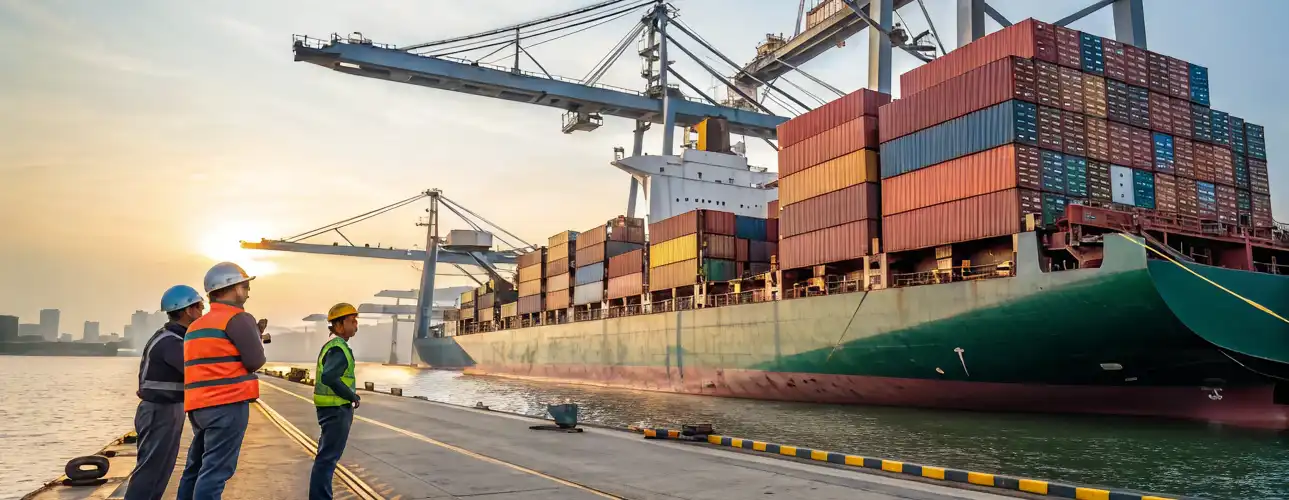


Why shipping feels like a black box
Moving cargo across borders should be simple: book space, load goods, deliver. In reality, international shipping feels more like solving a puzzle in a foreign language. Between unexpected fees, shifting transit times, and paperwork with names like Bill of Lading and Commercial Invoice, even seasoned businesses get caught off guard.
Here's the good news: once you understand the building blocks, the mystery fades.
This guide walks you through the true costs, timelines, and risks of global shipping. We'll highlight what professionals scan in a quote, common pitfalls that inflate your bill, and the smart steps that keep your supply chain predictable. By the end, you won't just know the numbers. You'll know how to control them.
Part 1: Visible costs, the tip of the iceberg
These are the baseline charges that should be on every quote. If a predictable cost isn't listed upfront, it's a red flag. Always make sure your quote clearly details:
- Freight rate: The core charge for ocean (FCL/LCL) or air (deferred/express) transit.
- Origin and destination handling: Terminal fees, security, loading, and standard port charges on both ends.
- Customs duties and taxes: An estimate based on the product's HS code, or at least the method for calculating it.
- Known surcharges: Any predictable fees like BAF (fuel), PSS (peak season), or GRI (general rate increase).
- Cargo insurance: A clear line item showing the cost to insure your goods, even if you choose to opt out.
- Free-time assumptions: The number of days you have at the port and with the container before extra charges begin.
The rule: If a cost is predictable, it belongs on the quote, not as a surprise on the final invoice.
Part 2: Hidden costs, where budgets blow up
Hidden costs don't appear on the initial quote, but they are the number one reason for budget overruns. They often show up when specific situations are triggered.
The most common culprits include:
- Demurrage: Fees for leaving a container at the port longer than the free period.
- Detention: Charges for returning an empty container late after unloading.
- Customs exams and services: Fees for inspections, X-rays, or special filings like ISF.
- Last-mile fees: Charges for specific delivery needs like a liftgate, residential drop-off, or a scheduled appointment.
- Documentation errors: Fines or re-filing fees caused by typos or mismatched details on paperwork.
Mini-case: how a $1,500 shipment turned into $2,400 (and how to prevent it)
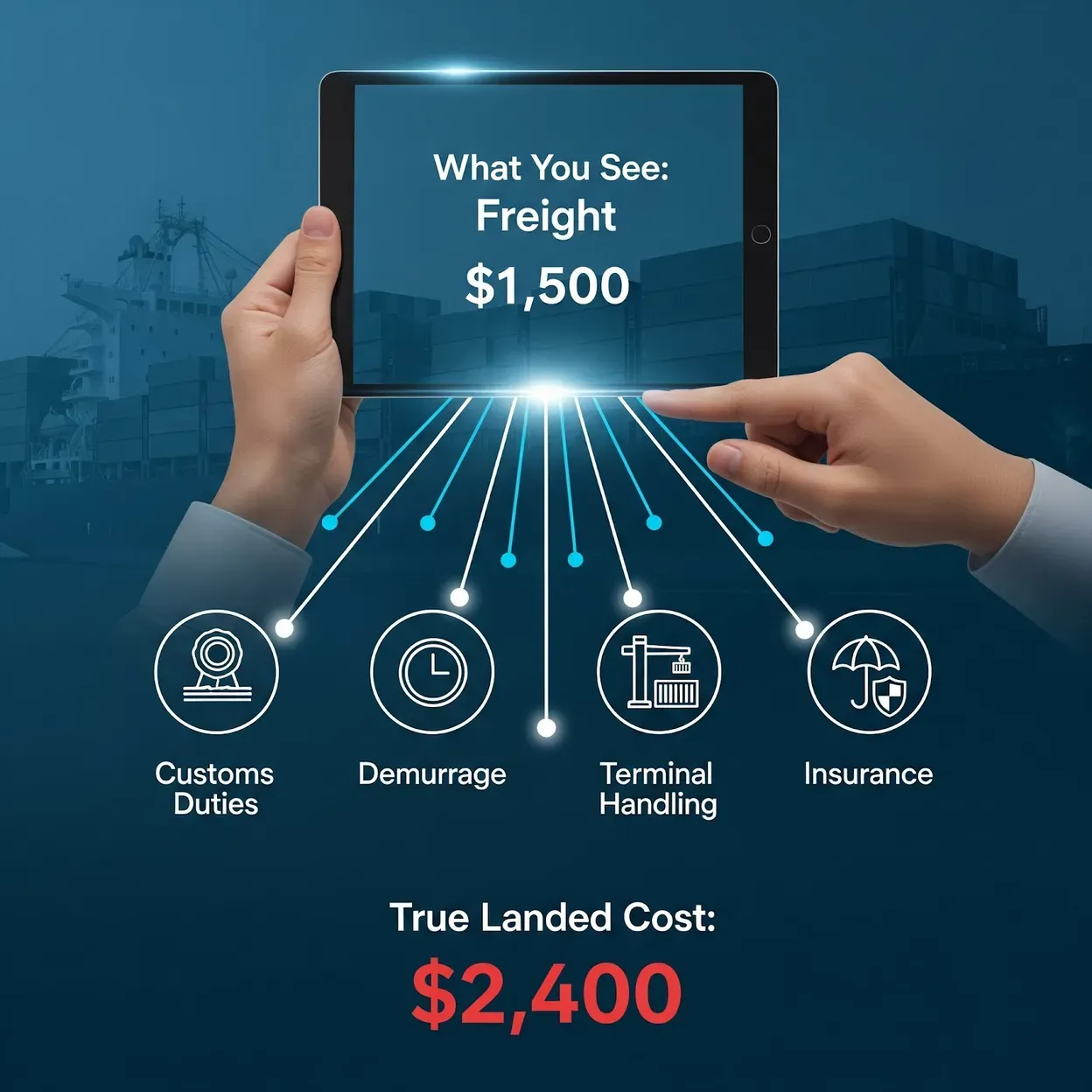
A business was quoted $1,500 for an ocean shipment from Los Angeles to Mumbai. That number looked great on paper. But by the time the cargo was delivered, the invoice totaled $2,400. Here's where the extra $900 came from:
- Destination handling/terminal charges (THC): $200. Every port charges for unloading, moving, and handling containers. It's standard, but it wasn't shown clearly in the initial quote.
- Duties and taxes: $300. Customs assessed import duties based on the product's HS code. These charges weren't calculated in advance, so they came as a surprise later.
- Last-mile trucking and fuel: $250. The shipment needed delivery from the port to the warehouse. This was billed separately, and because fuel surcharges were high that week, the cost jumped.
- Two extra days of demurrage: $150. The container sat at the port for two extra days because delivery wasn't arranged on time. Ports only give a limited "free time" window. Once that expires, the meter starts running daily.
Final invoice: $2,400. That's a 60% increase over the original quote.
What went wrong (and how to do it better)
- No clear breakdown in the quote. The shipper only looked at the base freight ($1,500).
- Fix: Always ask for a "landed cost estimate" that includes duties, handling, and delivery.
- No duty calculation in advance. Duties weren't estimated because HS codes weren't shared upfront.
- Fix: Confirm HS codes early and ask for a duty and tax estimate before booking.
- Delivery wasn't pre-booked. The container arrived before a trucker was arranged, which led to 2 days of demurrage.
- Fix: Always schedule your trucker before the vessel lands.
Part 3: Time costs, why every day matters
Time in shipping is never free. Every delay translates directly into business costs that don't appear on any freight invoice.
- Tied-up working capital: Goods stuck on a ship are assets you've paid for but can't sell. A two-week delay can mean thousands in unavailable cash flow.
- Missed sales windows: A shipment of seasonal goods arriving late can lead to lost revenue and heavy discounts.
- Delay-related fees: Congestion, strikes, or customs inspections often lead to storage and demurrage fees, compounding the financial impact.
Example: when 37 days turns into 45+
A freight forwarder gives you a schedule that says: transit time 37 days from Chennai to Los Angeles (port-to-port), the short end of the usual range on that lane.
Here's what that really means. Port-to-port is ship sailing time only. It counts from when the vessel leaves Chennai to when it docks in Los Angeles. It does not include the time before (loading, export customs) or after (import customs, delivery to the warehouse).
- Export prep (origin): 2–3 days (container pickup, loading, export customs).
- Sailing time (quoted): 37 days.
- Import clearance in Los Angeles: 3–5 days (longer if customs orders an exam).
- Port congestion or waiting for a berth: +2–4 days (common during peak).
- Delivery from port to warehouse: 2–3 days depending on trucking slots.
Reality check: 37 days on the quote often becomes 45+ days door-to-door.
Why this matters: If you plan inventory based on "37 days," you'll run out of stock or miss customer deadlines. If you build in a 10–15 day buffer, you protect your supply chain and cash flow.
Takeaway: Always ask your forwarder for door-to-door time estimates, not just port-to-port. That's the difference between a smooth delivery and two weeks of scrambling. For this lane specifically, see our Chennai to Los Angeles route guide.
Part 4: Risk costs, the invisible multiplier
Risk costs are the ones that don't appear in your quote but can blow up your budget if something goes wrong. They're invisible until they hit, and by then it's usually too late to react.
Mini-case: the $50,000 electronics shipment
A business shipped $50,000 worth of electronics by sea. Midway, the vessel hit bad weather, and containers were lost overboard.
Here's what happened next:
- The carrier's liability is capped by international convention and based on weight, not value. Under the Hague-Visby Rules the cap is 2 Special Drawing Rights (roughly $2.70 at recent exchange rates) per kg or 666.67 SDR per package, whichever is higher; under the U.S. Carriage of Goods by Sea Act it is $500 per package. Carriers can also deny liability altogether for losses caused by "perils of the sea" such as heavy weather.
- For this shipment, the most the business could hope to recover from the carrier was roughly $2,000.
- The business had no cargo insurance, so it had to absorb a loss of around $48,000.
Why this matters:
- Insurance looks optional, but it isn't. For a small premium (often under 1% of cargo value), that business could have claimed the full $50,000.
- Carriers rarely cover full value. Liability is limited by weight or package, not cargo value, unless you declare the value on the bill of lading and pay the carrier's higher ad valorem freight.
- Risk hits cash flow, not just margins. A sudden $48,000 loss can wipe out a quarter's profit for a small or mid-sized company.
How to protect yourself:
- Buy cargo insurance every time you ship anything you can't afford to lose.
- Know your exclusions ("All Risk" policies don't cover poor packing or inherent product defects). Our post on cargo insurance myths covers the common ones.
- Treat insurance as predictable cost control. You're trading a small, certain cost for protection from a massive, uncertain one.
Takeaway: Risk is the silent multiplier in shipping. Without insurance, one incident can erase years of careful cost management. With it, you turn an unpredictable disaster into a manageable line item.
Part 5: Strategic costs, the decisions that shape everything
Some of the most expensive shipping mistakes don't happen at sea or in customs. They happen at the planning table. The terms you agree to, the ports you choose, and the way you diversify (or don't) can quietly add thousands to your supply chain.
Wrong Incoterms (FOB vs. DDP)
Incoterms decide who pays for what, and when. For a full breakdown of every term, see our earlier article, Get the Terms Right: A Practical Guide to Incoterms.
For example, if you buy goods on FOB (Free on Board), the seller covers costs until the cargo is loaded on the ship. After that, it's your responsibility. If you buy on DDP (Delivered Duty Paid), the seller covers nearly everything until the cargo reaches you, but you often pay a premium price for that convenience.
Why it matters: A single word in your sales contract can shift responsibility for thousands in duties, taxes, and fees.
Smart play: Always confirm Incoterms in your purchase orders and contracts, and make sure they reflect your actual cost and risk appetite.
Poor port selection
Cheaper freight rates can trick you into choosing the wrong port. Say your shipment lands at a congested port like Los Angeles instead of a less busy one like Oakland. On paper, the ocean rate is cheaper, but once you add inland trucking, congestion surcharges, and demurrage for delays, your "savings" vanish.
Why it matters: The port you choose decides not only transit time but also last-mile cost and reliability.
Smart play: Don't just compare port-to-port rates. Look at total landed cost, including trucking, handling, and delivery.
Supplier and route over-reliance
If all your shipments depend on one supplier or one trade lane, you're exposed. When that lane faces disruption (congestion, a strike, a policy change), you're stuck paying "panic rates" for last-minute space elsewhere. Diversification, sourcing from multiple suppliers or using alternative routes, protects you from being cornered.
Why it matters: Over-reliance locks you into paying whatever the market demands when disruption hits.
Smart play: Use a "China+1" or "multi-route" sourcing strategy, so you're never forced into one expensive option.
The big idea
The cheapest quote isn't the smartest strategy. Short-term savings on rates often hide long-term costs in duties, delays, and disruptions. Shippers who win treat strategy as cost control:
- They negotiate clear Incoterms.
- They choose ports based on landed cost, not just freight rates.
- They spread risk across suppliers and routes.
In the long run, this approach saves far more than shaving $50 off a freight quote.
Your cost control playbook: putting the framework into action
You've seen how costs stack up. Now let's turn that framework into something practical: a checklist you can actually use before booking.
What pros scan first on any quote
Seasoned shippers don't just glance at the bottom line. They look for the red flags that cause trouble later. Here's how to scan a quote like a pro:
- Mode and service level: Ocean (FCL/LCL) or air (express/deferred), and the promised transit time.
- Named surcharges: Fuel (BAF), peak (PSS), general rate increases (GRI), security fees. If they're not listed, ask.
- Origin and destination handling: Are both sides covered, or will you face a "destination surprise" bill?
- Duties and taxes: Is there a number, or just "to be calculated"? If it's the latter, you're flying blind.
- Free time: How many days before demurrage and detention fees kick in? Three vs. seven days can make or break your margin.
- Insurance: Is it included, excluded, or optional at an extra cost?
- Assumptions and exclusions: This is the fine print, and it's where most "surprises" are hiding.
Pro tip: If a cost is predictable, it belongs on the quote. If it's missing, don't ignore it. Ask why.
The pre-booking checklist (your safety net)
Think of this as your "don't-sail-without-it" list. Checking these boxes prevents most of the surprise charges that blindside new shippers.
- Incoterms confirmed in writing. Know exactly who pays for what, from factory door to your warehouse.
- HS codes validated and shared. Duties and taxes are calculated from these; if they're wrong, you pay the price.
- Exact cargo dimensions and weight shared. Send packaging photos too. This avoids re-quotes and surprise reclassification fees.
- Certificates ready. Certificate of Origin, fumigation, compliance documents. Missing paperwork means storage fees and delays.
- Free time confirmed in writing. Don't assume you get seven days at the port. Get it in black and white.
- Delivery appointment pre-booked. Truck and chassis secured before the vessel lands means no costly demurrage.
- Insurance decision made. Either include it or formally decline it. What you don't decide now can sink you later.
Conclusion: see the whole picture, not just the price
Great shippers don't chase the lowest quote. They eliminate uncertainty.
By following this framework, you can:
- Anticipate fees before they hit.
- Lock down documents and timelines so nothing slips.
- Protect your cargo and your cash flow.
When your quote shows the must-haves, names the situational add-ons, and states assumptions clearly, you stop being surprised and start being in control.
Quick FAQ
Can the cheapest quote still be expensive?
Yes, if it hides terminal fees, gives you too little free time, or routes you through a congested port with high last-mile trucking costs.
What's the fastest way to blow my budget?
Demurrage and detention. Slow paperwork and late container returns are silent profit killers.
Do I really need insurance?
If you can't replace the entire shipment with cash tomorrow, then yes, you need insurance.
Want to go deeper?
Explore more guides from our shipping library:
Get a quote for your shipment
Have a shipment to move? Send the origin, destination, cargo, and container size or weight. We reply with the rate, the routing and the services included.
