

Update, September 27, 2026: This post was written in October 2025. The final step of the EU ETS phase-in it describes is now in force: 2026 emissions are covered at 100% (surrendered by September 30, 2027), and methane and nitrous oxide are counted alongside CO₂ from 2026. The sections below have been updated to match.
Ocean freight invoices in 2024 began showing a new cost line: the ETS surcharge. ETS stands for the European Union's Emissions Trading System, and the surcharge is how ocean carriers pass the cost of EU carbon allowances on to shippers. For many importers, it first appeared as a minor environmental compliance fee with limited budget impact. That changed in 2025, and again in 2026.
The EU phased shipping into the ETS in three steps. Carriers had to cover 40% of their reported 2024 emissions with allowances, 70% of their 2025 emissions, and 100% from 2026 onward. That makes the ETS surcharge a growing and permanent part of ocean freight costs.
ETS compliance timeline: 2024 to 2026
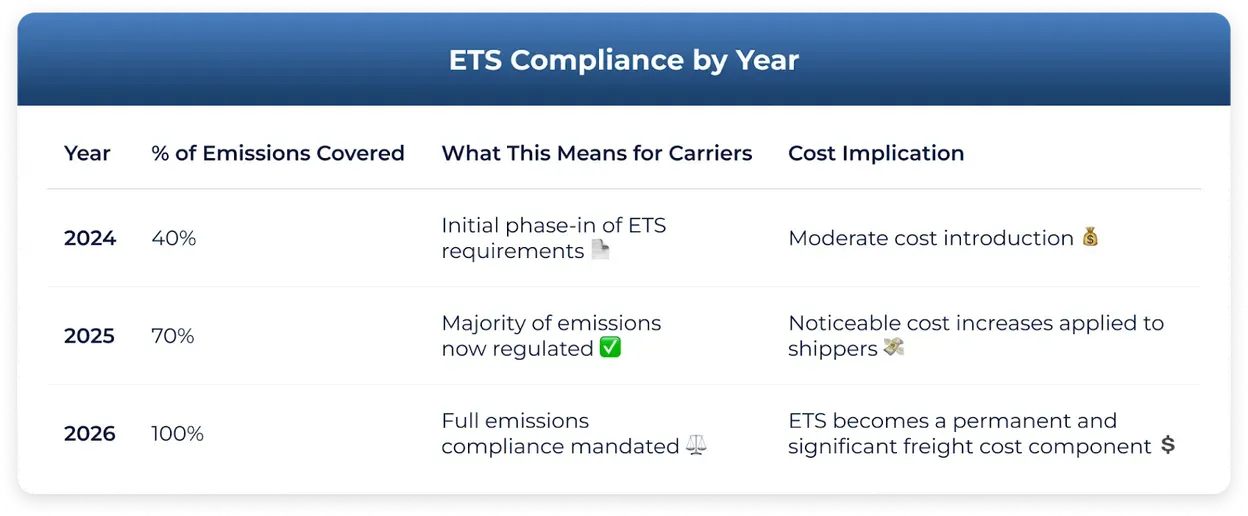
Allowances for each year's emissions are surrendered by September 30 of the following year, so the 100% step for 2026 emissions is settled in 2027. From 2026, methane and nitrous oxide emissions also count, which matters most for LNG-fueled ships.
While the ETS is an EU policy, an ETS line can still turn up on an invoice for a lane that doesn't end in Europe, for example a South Asia or Middle East routing that transships through a European port. Carriers' published ETS surcharges are tied to EU-related voyages, so an ETS charge on a lane with no EU leg at all, such as a direct Asia–U.S. sailing, deserves a question. Understanding why it appears is essential for accurate landed cost planning.
What is the ETS surcharge?
The EU Emissions Trading System is a cap-and-trade mechanism designed to reduce greenhouse gas emissions. Under this system, ocean carriers must buy and surrender carbon allowances (known as EUAs, one per tonne of CO₂-equivalent) to cover emissions from voyages involving EU ports. It applies to cargo and passenger ships of 5,000 gross tonnage and above.
The allowance cost is not optional: carriers must pay it to comply with EU law. The surcharge is the carrier's way of recovering that cost from cargo owners, usually as a per-container charge that carriers such as Maersk and MSC review periodically in line with EUA prices.
How carriers calculate the ETS surcharge
Each carrier sets its own method, but most follow the same logic:
- Emissions per container for the service, based on the ship's fuel use and the number of containers carried.
- Share of the voyage covered. 100% of emissions on voyages between two EU/EEA ports and while at berth in an EU port, and 50% of emissions on voyages into or out of the EU/EEA.
- The phase-in percentage for the year (40%, 70%, then 100%).
- The EUA price, which trades on the open market and moves with it.
This is why the surcharge differs by carrier, lane, container size and ship, and why it changes when carriers review their tariffs.
Why ETS surcharges can appear on non-EU trade lanes
The ETS regulation itself only applies to voyages that load or discharge cargo at an EU port. A transshipment call at a nearby non-EU hub does not avoid it: the EU has designated Tanger Med (Morocco) and East Port Said (Egypt) as ports where container ship stops do not break the voyage for ETS purposes.
So an ETS line on a shipment that never touches Europe usually has one of two explanations:
- The routing has an EU leg you didn't expect, such as transshipment at an EU port or a service that also calls in Europe.
- The cost is being recovered more broadly than the EU voyages it relates to. Nothing in EU law requires this, and major carriers publish their ETS surcharges for EU-related trades, so ask for the basis of the charge. Shippers have also questioned how closely ETS surcharges track the emissions they are meant to cover.
What this means for importers
- If a shipment from Asia to the U.S. carries an ETS surcharge and the cargo never calls in Europe, the EU regulation does not require that charge.
- In that case the surcharge reflects how the carrier or its agent allocates costs, not the regulatory scope of your shipment.
- It is reasonable to ask your carrier or forwarder which EU leg, if any, the charge relates to.
For importers, the key takeaway: ETS surcharges are a recurring cost to plan for on any routing with an EU leg, and worth querying on routings without one.
What the ETS surcharge means for your freight budget
The ETS surcharge reflects carrier compliance with EU carbon regulations, and the regulation behind it cannot be waived. How carriers calculate and allocate the charge is still debated in the industry. With ETS coverage at 100% from 2026, and with allowance prices moving on open markets, its share of freight costs can rise.
Importers who do not account for ETS in forward budgets may face unexpected cost overruns. Those who model ETS as part of their landed cost planning are better placed to manage pricing and protect margins. If you buy on terms where the seller arranges the main carriage, check which party the surcharge falls on; our Incoterms guide shows how costs split under each term.
How importers are responding
Industry data and importer behavior point to more proactive freight planning:
1. Evaluating carrier emissions profiles
Carriers deploying newer, fuel-efficient or alternative-fuel vessels may pass on lower ETS costs.
2. Requesting all-in cost visibility
Rather than evaluating base ocean rates alone, importers are increasingly asking for full landed cost forecasts, including ETS projections, and comparing them across carriers on lanes such as China to the USA.
3. Including ETS in annual budgeting
Many businesses now add a "sustainability compliance" line to freight budgets to account for ETS and similar carbon charges.
Conclusion: planning now vs. reacting later
The ETS surcharge is no longer a short-term adjustment. It is part of the global freight cost structure. The regulation applies only to EU-related voyages, but an ETS line can still reach importers on other lanes through an EU transshipment leg or broader cost recovery, so check the basis of any ETS charge on an Asia–U.S. invoice.
When freight costs are shaped not just by fuel and capacity but also by environmental compliance, understanding your true landed cost is essential to protecting profitability.
At Airlift USA, we monitor ETS developments and carrier advisories to help importers see cost changes early, not after invoices are issued.
If you would like a lane-level overview of how ETS may affect your freight costs, talk to our team for a neutral cost planning breakdown based on current carrier guidance. This is not a sales consultation. It is a planning discussion designed to support cost transparency.
For importers planning the year ahead, clarity is no longer optional. It is a financial requirement.
Get a quote for your shipment
Have a shipment to move? Send the origin, destination, cargo, and container size or weight. We reply with the rate, the routing and the services included.
