


Update, September 27, 2026: This post was written in December 2025 for the Q1 2026 booking season, which has now passed. Lunar New Year fell on February 17, 2026 and Ramadan ran from about February 18 to March 19, 2026, so Ramadan began the day after the holiday and ran through the post-holiday restart. The same squeeze returns in 2027: Lunar New Year falls on February 6 and Ramadan is expected to begin around February 8 (moon-sighting dependent). The method still applies: work back from your delivery date using current transit times, and check blank sailings on your lane.
Last week, we mapped the 60-day Q4 to Q1 transition window.
This week, we're inside it, and the early signals point to a very unusual Q1 for importers.
Two global events are converging in early 2026:
- Lunar New Year: February 17. China's factories close, and carriers divert equipment toward pre-holiday exports.
- Ramadan: about February 18 to March 19. Productivity slows across Bangladesh, parts of India, and segments of the wider Muslim logistics workforce.
Why This Matters More in 2026
Q1 disruptions happen every year, but 2026 is structurally different because Ramadan begins the day after Lunar New Year. There is no gap for carriers to rebalance equipment between the two.
What is normally a 4–6 week global reset period all but disappears.
This creates a bottleneck: there simply isn't enough time between the two events for carriers to reposition containers and normalize vessel rotations.
The result is a period where equipment shortages and vessel constraints emerge across South and Southeast Asian export lanes at the same time. The system doesn't get the breathing room it normally relies on.
If you're shipping from India, Vietnam, Bangladesh, or Cambodia and need February or March arrivals, December planning gives you far more control than January decisions.
The Equipment Problem (Visualized)
Think of containers like rental cars at an airport.
In normal cycles (45–60 days):
China exports, empties return to India/Vietnam/Bangladesh, repeat.
Right now (December):
Carriers are holding containers in China to serve pre-LNY exports.
Fewer empties are returning to your origin markets.
January–February:
As China shuts for LNY, empties accumulate in China.
South and Southeast Asian factories may produce, but loading containers becomes harder. Ramadan starts in the same week.
March:
China restarts.
Carriers rush empties to China, not to India/Vietnam/Bangladesh.
Ramadan continues until about March 19, so productivity reductions compound the supply-side strain.
According to the Journal of Commerce, carriers are already "adjusting capacity on India routes via blank sailings" to reposition equipment globally. This typically signals tightening ahead.
Why This Year Feels Different
LNY and Ramadan each occur annually, but in 2026 they fell back to back.
Typical year
LNY, then 3–5 weeks of equipment recovery, then normal rotations resume.
2026
- LNY shutdown: Feb 17
- Ramadan begins: about Feb 18
- Equipment still returning: late Feb, with Ramadan already under way
The global network cannot normalize in time.
Carrier behavior reinforces this:
J.P. Morgan's 2025 analysis (via JOC) notes carriers maintaining "idle and scrap rates well below pre-pandemic levels," meaning capacity is intentionally tight even in soft demand cycles.
When carriers must prioritize, China–US, a lane 10x larger, typically receives first allocation.
South and Southeast Asia feel the downstream effects.
Your Booking Windows (Work Backwards from Delivery Date)
| Lane | Transit | Book by | Delivery target |
|---|---|---|---|
| India to US East Coast | 28–35 days + clearance | Early to mid December | February |
| Early January | March | ||
| India to US West Coast | 18–22 days | Mid December | February |
| Mid January | March | ||
| Vietnam to US West Coast | 16–20 days | Late December | February |
| Late January | March | ||
| Bangladesh to US East Coast | 30–38 days (via Colombo) | Early December | February |
| Late December / early January | March |
Pattern: Longer routes = earlier cutoffs.
Bangladesh and India–USEC are the earliest to tighten. Lane detail: India to USA, Bangladesh to USA, Vietnam to USA.
Three Booking Scenarios (Based on Historical Patterns)
Scenario A: Book in Early December (Ideal)
Recent late-2025 ranges:
- India–USEC: $2,400–2,800
- Vietnam–USWC: $2,200–2,600
- Bangladesh–USEC: $2,600–3,000
Equipment generally available
High February delivery probability
Minimal downside on rates
Scenario B: Book Late December
Historical pre-LNY data (JOC):
- Rates rise $300–600
- Equipment tightens
- February delivery becomes 50/50
- Rollovers more likely
Scenario C: Book in January
Rates typically $600–1,200 higher
- Equipment shortages significant
- February delivery LOW probability
- Air freight becomes fallback (5–8x ocean cost)
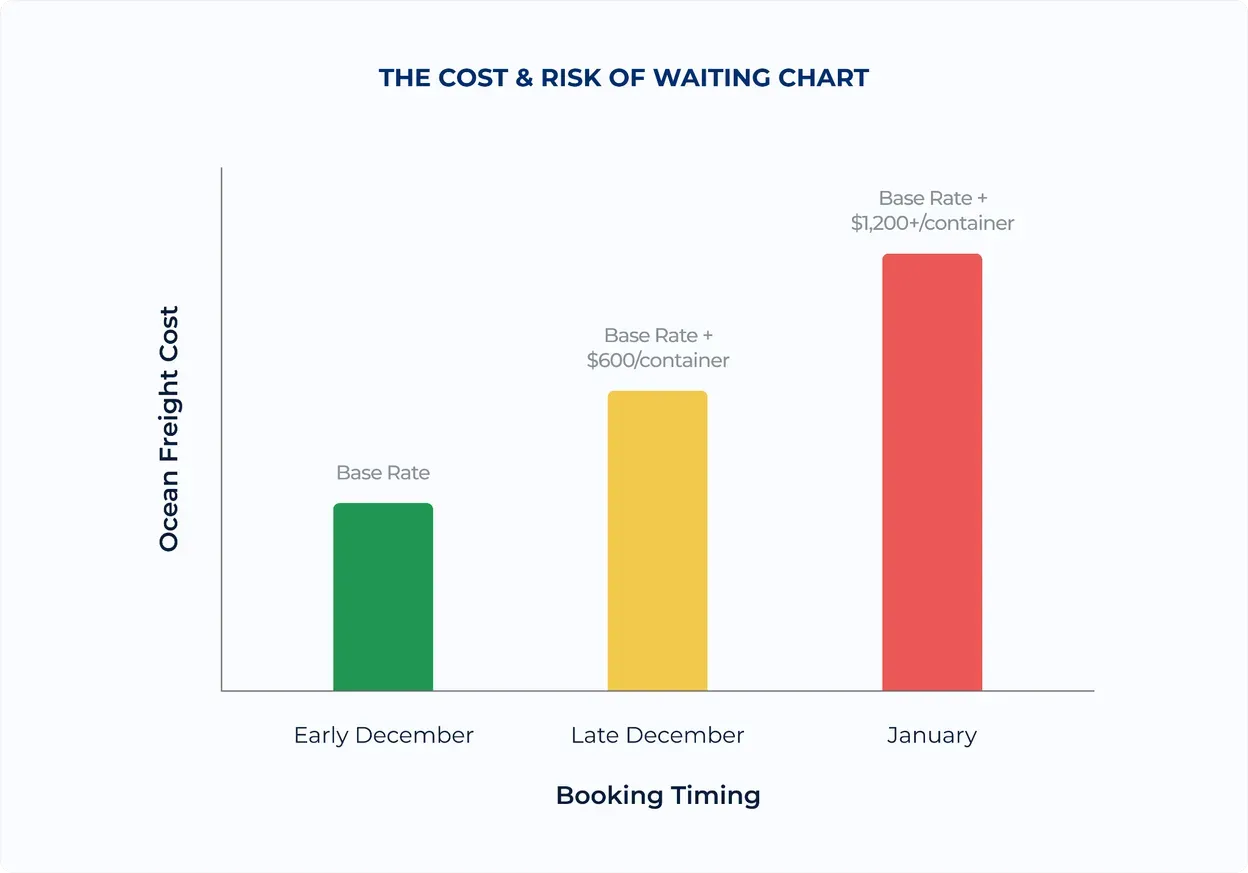
Example: 20 FEUs (India to USEC)
- Early Dec: $48,000–56,000
- Late Dec: $54,000–68,000
- January: $60,000–80,000+
Waiting rarely pays off in a capacity-managed cycle.
Carrier Behavior Confirms the Pattern
When China bookings fell 30–60% in April 2025, carriers did not cut rates.
Instead, they blanked 12 sailings, removing 32,000 TEUs (JOC).
A carrier executive told JOC:
"Vessel utilization is dropping, so we'll accelerate our blank sailing schedule."
Current intra-Asia data reinforces this:
- Shanghai to Singapore: $540/TEU (highest since January)
- Shanghai to Bangkok: $1,431/FEU (highest since August)
- Bi-weekly GRIs on Asia lanes: "always successful," per forwarders
This is the post-COVID carrier playbook:
Price discipline through capacity discipline.
What to Do in the First Week of December
1. Work backward from delivery dates
Use the booking windows above.
Add buffer for transshipment ports (Colombo, Port Klang, Singapore).
2. Segment your SKUs
- Critical items: book early
- Flexible items: partial hold
- Mixed: split volumes
3. Validate equipment availability
Ask:
- "What's my equipment allocation for Dec/Jan?"
- "Any blank sailings on my lane?"
4. Lock critical lanes before December 13
Especially:
- India to USEC
- Bangladesh to USEC
- Vietnam to USWC
These historically tighten first.
The Ramadan Factor (Why March Isn't a Relief Month)
Ramadan 2026: about February 18 to March 19 (dates depend on moon sighting).
Historical patterns show:
- Bangladesh: 20–30% productivity reduction during fasting hours
- India: Sector-specific slowdowns (textiles, leather, logistics)
- Southeast Asia: Reduced trucking and port throughput
The issue?
Equipment begins rebalancing in late February, when Ramadan is already under way.
So late February and early March don't relieve LNY pressure. They overlap with the next slowdown.
Bottom Line
Your factories may remain open during LNY, but your supply chain still depends on where containers are and which lanes carriers prioritize.
With Ramadan starting a day after LNY, the global reset cycle has almost no room at all.
JOC's 2025 reporting repeatedly shows:
- Carriers blank sailings even at low utilization
- GRIs hold despite soft demand
- Idle capacity remains low
- Asia trades see bi-weekly increases that succeed
This quarter isn't about getting the lowest rate.
It's about securing reliable movement in a structurally tight cycle.
Importers who plan in early December typically gain:
- Earlier delivery windows
- Higher equipment availability
- Lower exposure to January volatility
- More room to maneuver if forecasts shift
Those who wait for January often face reduced options.
If you're shipping from India, Vietnam, Bangladesh, or Cambodia, this is a good week to reassess your Q1 capacity plan.
Want Support Evaluating India–US, Vietnam–US, or Bangladesh–US Capacity?
Our teams monitor equipment availability, sailing schedules, and carrier allocations across Asia.
Schedule a 15-minute capacity review or connect on LinkedIn to discuss your trade lane.
Get a quote for your shipment
Have a shipment to move? Send the origin, destination, cargo, and container size or weight. We reply with the rate, the routing and the services included.
