

Update, September 27, 2026: This post was written for the first week of January 2026, which has passed; the restart pattern it describes repeats every January. Much of the tariff uncertainty behind the "tariff-protection" front-loading in risk 4 centered on the IEEPA tariffs: on February 20, 2026 the Supreme Court held that IEEPA does not authorize tariffs, and CBP stopped collecting IEEPA duties on February 24, 2026. See IEEPA tariff refunds and current tariff updates.
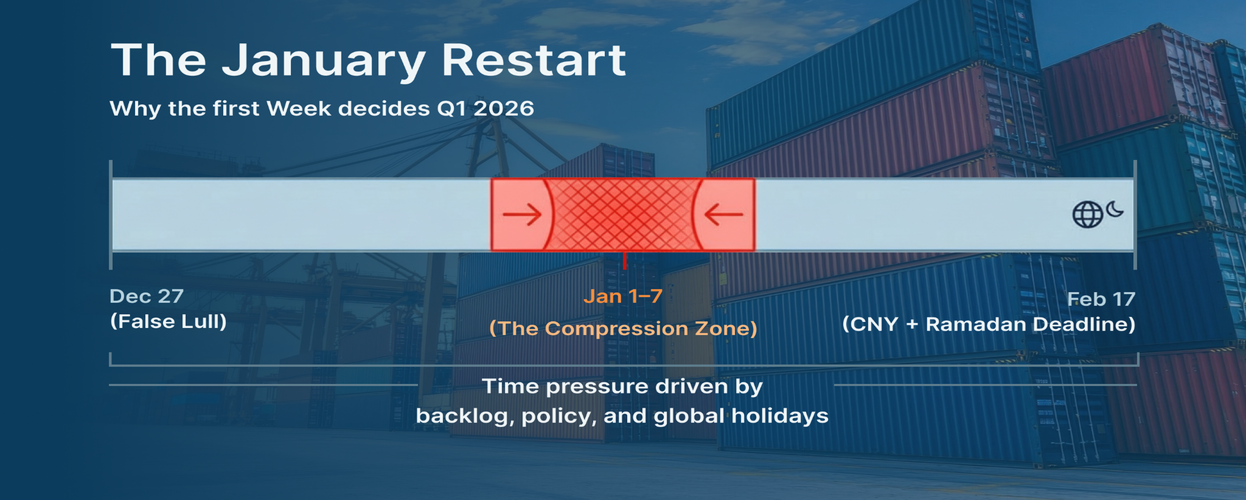
The first week of January 2026 isn't neutral territory. It's when:
- Post-holiday backlogs clear, or don't
- Q1 shipment windows compress
- Coordination gaps from December surface
- Chinese New Year preparation quietly begins
Most importers treat January 1–7 as "getting back to normal." In reality, it's a critical planning window that sets the tone for all of Q1 2026.
What's Actually Happening January 1–7, 2026
While many teams are just returning to work, the freight system hasn't been waiting.
Ports
Terminals begin clearing containers that arrived in the final days of December. Reduced holiday staffing means these boxes often move later than planned, and whether they flow smoothly depends entirely on how well pickup, documentation, and inland moves were coordinated before the break. Our late-December holiday blind spot post covers those arrivals.
Customs
Processing resumes at full pace, but with a backlog. Holds and customs exams that built up over the holidays are worked through in the first weeks of January, so exam-related delays are more likely than in a normal week.
Warehouses
Receiving windows tighten immediately. Everyone restarts at once, and warehouse capacity that looked flexible in late December fills quickly once operations normalize.
The "Double Header" Risk: CNY + Ramadan
Chinese New Year in 2026 falls on February 17. But here's the catch: Ramadan is projected to begin around the same date.
This creates a rare double-header disruption.
While China slows for CNY, workforce productivity in key sourcing regions, including parts of Southeast Asia, South Asia, and the Middle East, often shifts during Ramadan observances.
The result is not just a China pause, but a regional capacity tightening.
The "Plan B" options importers often rely on during CNY, such as shifting production or volume to alternate Asian origins, will be operating at reduced speed at the same time. That overlap shortens recovery windows and increases competition for available capacity earlier than most expect.
Even though CNY is later in 2026, the January restart backlog still consumes the first week of the year, leaving a compressed four-week window to move cargo before pre-CNY and Ramadan effects fully take hold.
None of this is unusual in isolation.
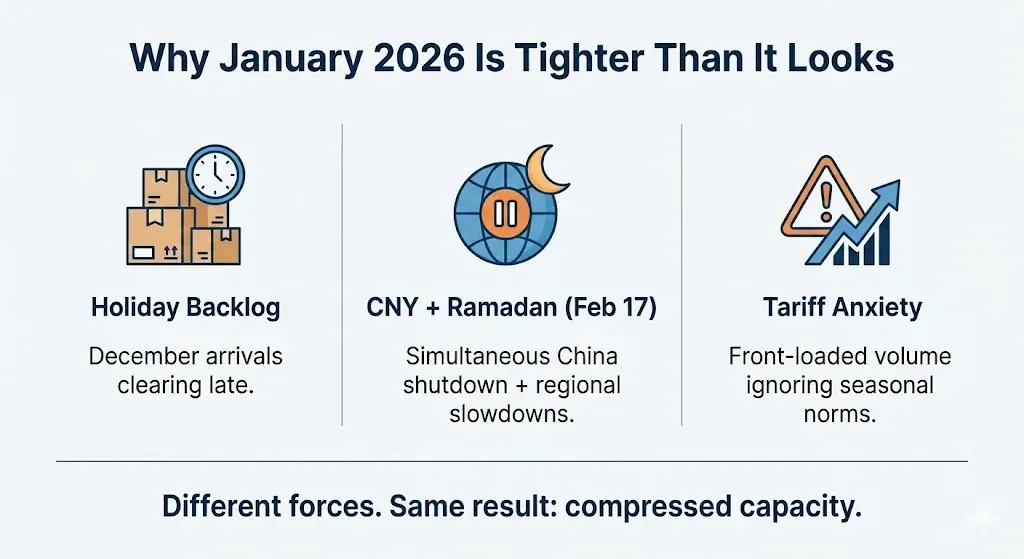
What's different is that it all converges at once.
The Four Restart Risks Importers Face
January problems rarely start in January.
They start in December, and surface together after the break.
1. Delayed Clearance from December 2025
Shipments arriving between December 23–31 often carry unresolved issues: pending exams, missing documents, or unconfirmed pickup plans. These don't disappear over the holidays. They stack.
2. Compressed Coordination Windows
When ports, warehouses, truckers, and brokers all restart simultaneously, there's no margin for error. A missed handoff in early January can quickly turn into multi-day delays.
3. The False Comfort of a Later CNY
With Chinese New Year landing on February 17, many importers assume they have extra time. In practice, the January backlog pushes recovery into mid-month, meaning by the time operations feel "clear," they're already overlapping with pre-CNY booking pressure. We cover that window in Pre-LNY 2026: the importer's risk window.
4. The "Tariff-Protection" Volume Spike
Unlike a normal year, January 2026 capacity is being absorbed by importers front-loading inventory ahead of potential tariff changes. This political volume ignores seasonal norms and books space aggressively, often at any price, creating artificial shortages that affect even well-planned shippers.
What This Looks Like in Practice
A container arriving December 27 may not clear customs until January 3–4.
Drayage may not be available until January 6–7.
The warehouse may not receive it until January 8–9.
What looked like a five-day process becomes twelve, not because anything went wrong, but because of timing.
What Importers Can Control
You can't change the calendar.
But you can control how prepared you are for the restart.
- Clear any December 2025 holdovers first; don't let them compete with January arrivals
- Pre-file customs entries for January shipments to reduce exam exposure
- Coordinate drayage and warehouse capacity before offices fully reopen
- Secure February 2026 space early, before pre-CNY tightening begins
January rewards preparation, not urgency.
The January 2026 Coordination Checklist
Before the first full week of January, confirm:
- December 2025 containers: clearance status and immediate pickup plan
- January 2026 arrivals: customs pre-filing completed, drayage booked
- Warehouse capacity: receiving windows confirmed for January 6–15
- February 2026 bookings: space secured ahead of pre-CNY pressure
- Inland moves: rail and truck availability aligned early
Closing
The holidays didn't pause freight.
They compressed it.
January 1–7, 2026 is when that compression releases, and importers who plan for the restart outperform those who assume it will "just work."
Q1 2026 doesn't start on January 1.
It starts with how you coordinate the first week.
Get a quote for your shipment
Have a shipment to move? Send the origin, destination, cargo, and container size or weight. We reply with the rate, the routing and the services included.
