


Update, September 27, 2026: CPSC eFiling became mandatory on July 8, 2026: certificate data for CPSC-regulated consumer products is now filed in ACE at the time of entry. The January 8, 2027 date for products imported into a Foreign Trade Zone is still ahead. For what the requirement covers, see CPSC e-Filing Becomes Mandatory.
January 2026
Most compliance changes give importers two choices:You ignore it until the last month.Or you deal with it early.
This one doesn’t work like that.
Because July 2026 isn’t a policy update. It’s a process change.And process changes don’t fail loudly.They fail at the worst moment — when the cargo is already at the port.
It’s not “more paperwork.” It’s a different clearance model.
For years, most importers treated CPSC certificates the same way:You keep them on file.And if Customs asks, you provide them.
That mindset stopped working in July 2026.
Since July 8, 2026, CPSC certificate information has to be electronically filed into ACE as part of entry. Not later. Not “if requested.” Not when someone has time.
At a practical level, that means compliance shifts from:“We have the document” to“We can execute the data.”
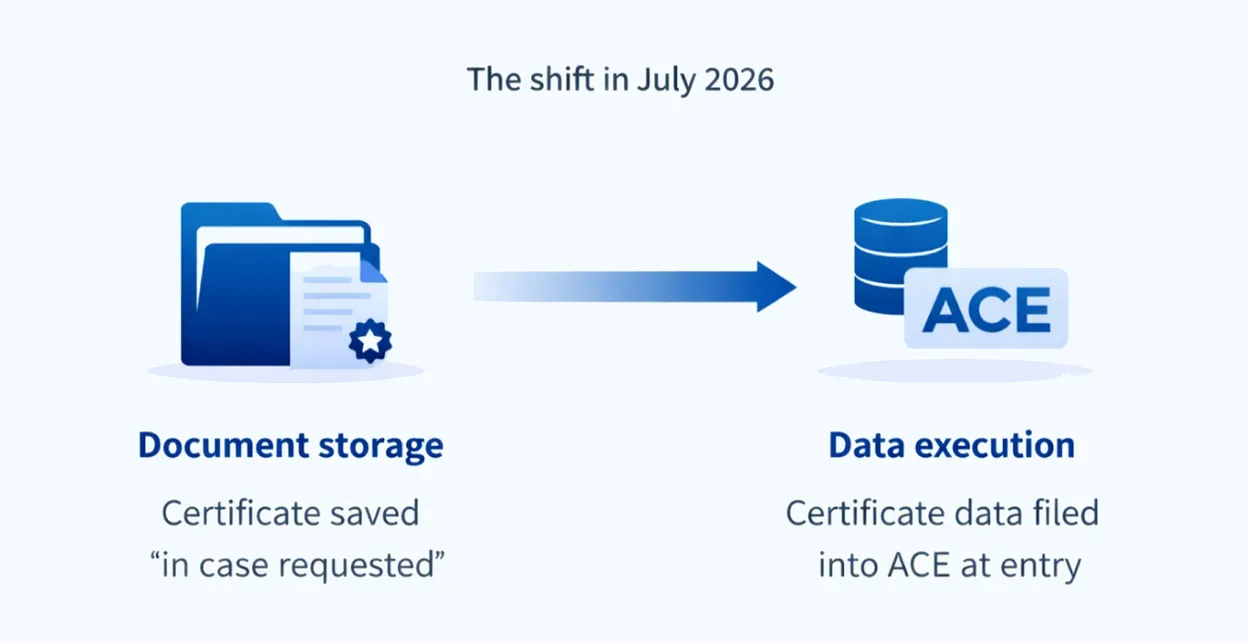
And those are not the same thing.
What’s fixed (and what isn’t)
July 8, 2026: Mandatory electronic filing for CPSC-regulated consumer products at the time of entry
January 8, 2027: Mandatory electronic filing for CPSC-regulated products imported into a Foreign Trade Zone (FTZ)
Service patterns, routing, and schedule changes will keep happening — but compliance systems won’t become more forgiving because your plan changed
The industry message has been consistent: don’t treat this like a switch.
This came up clearly in the NCBFAA “Year in Review” discussion on the Simply Trade podcast.The tone wasn’t dramatic — it was realistic.
The point was simple: importers who treat July 2026 like a switch they can flip at the last minute are going to feel it operationally first. Not through fines.Through manual work, delays, and holds.
That’s what makes this deadline different.It doesn’t punish you in theory.It punishes you in execution.
The real bottleneck isn’t your broker. It’s your upstream data.
Most companies assume their broker will “handle the filing.”But brokers can’t file what they don’t have.
And the data that’s usually missing isn’t exotic — it’s basic, operational, and messy:
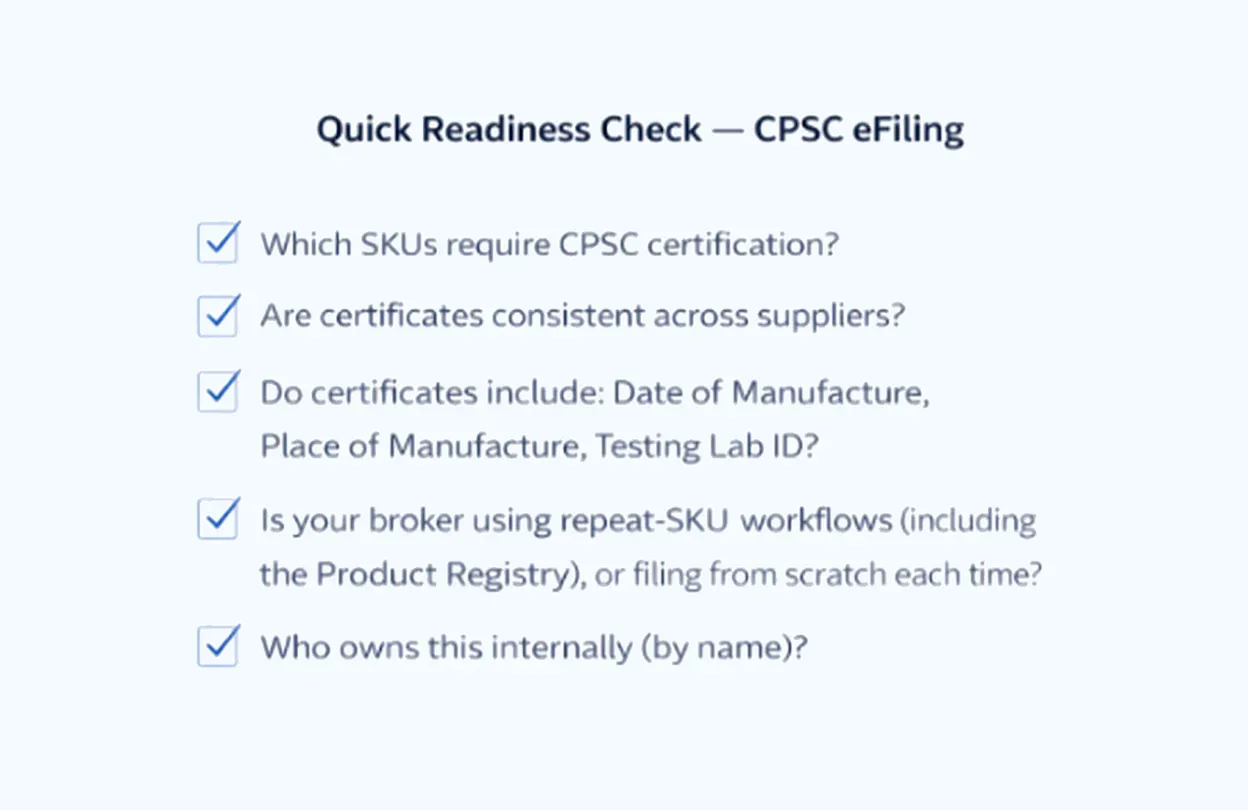
Date of Manufacture
Place of Manufacture
Testing Lab ID / details
“Date of manufacture” is the one that quietly breaks teams.Because it changes by batch, it lives in supplier systems, and it’s rarely captured consistently.
So even importers who have certificates today often discover their certificates aren’t actually entry-ready.They’re just “stored.”
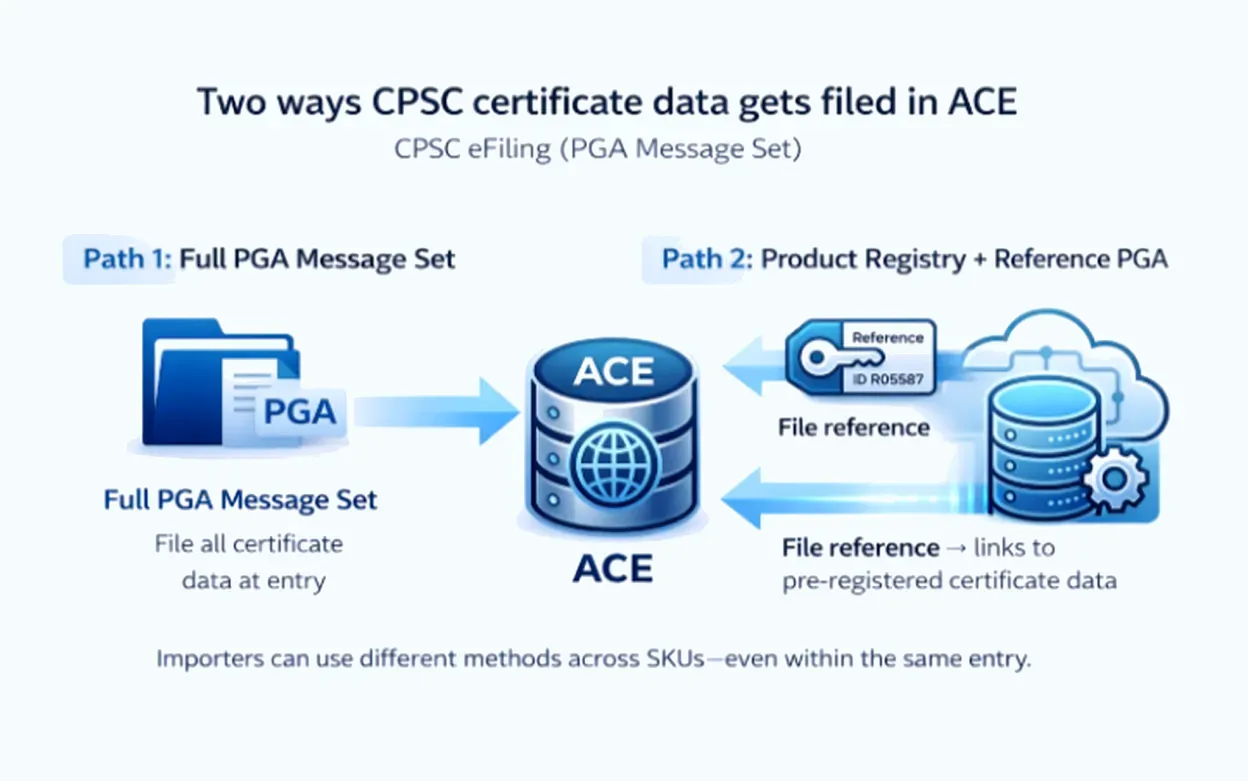
Two ways importers (or their brokers) will file CPSC certificates in ACECertificate data is typically filed using one of two methods:
Full PGA Message Set: filing all Certificate of Compliance data at the time of entry
Product Registry + Reference PGA Message Set: filing only a reference at the time of entry that links to Certificate of Compliance data stored in the CPSC Product Registry
Importers may choose to switch between these methods across different products — including products within the same entry.
The hidden risk: small plan changes now carry bigger consequences.
In a normal week, supply chains don’t run perfectly.A sailing slips.A port rotation changes.A container gets rolled.A SKU is substituted.
In the past, those changes were annoying — but fixable.
Now the compliance side is getting more rigid.Structured filing and automated reviews don’t love late changes.
So the real risk isn’t “you forgot to file.”It’s this: your plan changes after you filed.
That’s when teams get stuck chasing amendments and exceptions while the shipment is already moving.
The Product Registry is the scaling lever — if your data is clean.
For importers shipping repeat SKUs, the CPSC Product Registry can reduce repetitive work.It’s basically the difference between:filing from scratch every timevsreferencing something you’ve already standardized
But it only works if your upstream certificate data is consistent.
So one broker question matters more than people realize:“Are we filing full data for every shipment, or using the Product Registry for repeat SKUs?”
That answer tells you whether CPSC filing is routine — or manual.
What to do now (without making this a six-month project)
This doesn’t need a transformation program.It needs two things:ownership and a test run.
Pick your top CPSC-relevant SKUs.Pick one supplier.Pick one lane.
Then run the process end-to-end:Can your supplier provide the data cleanly?Can your broker file it without chasing fields?Can your internal team validate it before the shipment moves?
That’s it.
Because if the process works for your most common shipments, scaling becomes manageable.If it doesn’t work for your most common shipments, every entry becomes manual work.
When this post was published in January 2026, importers had roughly 24 weeks. That sounded like plenty.It wasn’t — especially where certificates needed updates or retesting, or where supplier data wasn’t consistent. For goods imported into a Foreign Trade Zone, the January 8, 2027 date is still ahead.
The takeaway
This isn’t a crisis.But it was a cutoff.
July 8, 2026 has passed, and the requirement is in force.And the companies that clear smoothly won’t be the ones who “react fast.”
They’ll be the ones who treat compliance like execution — early enough that it becomes boring.
That’s the goal.
Resources (worth bookmarking)
Get a quote for your shipment
Have a shipment to move? Send the origin, destination, cargo, and container size or weight. We reply with the rate, the routing and the services included.
