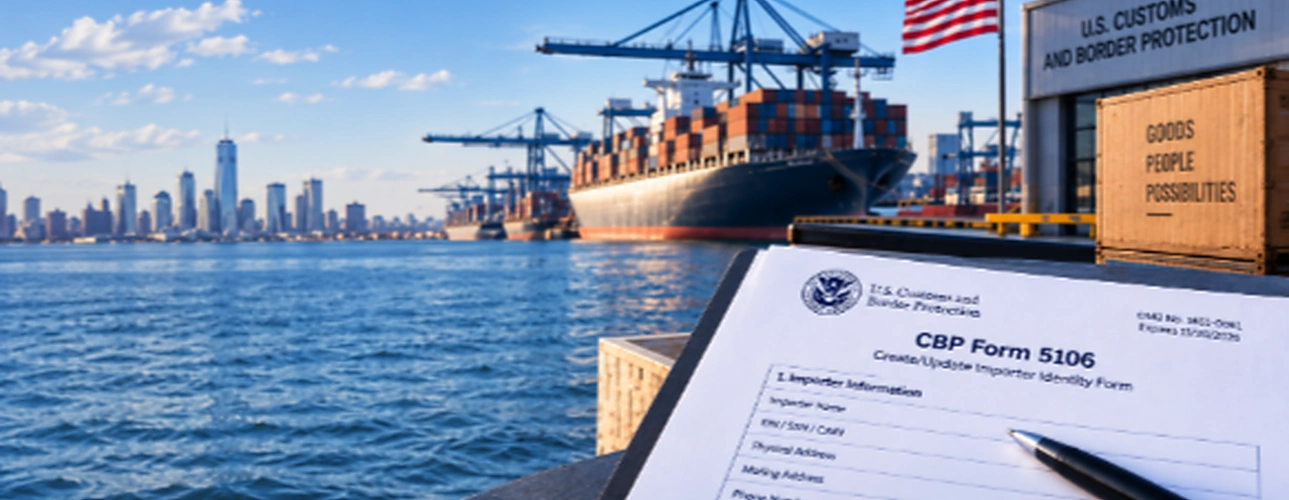


Importer of Record (IOR): What U.S. Importers Need to Know About CBP Form 5106
If you import goods into the United States, your freight rate, tariff classification and customs duties are only part of the compliance picture.
There is another piece of information that can determine whether your goods can be entered into the country: your Importer of Record (IOR) information.
U.S. Customs and Border Protection (CBP) uses Form 5106 — Create/Update Importer Identity Form to establish and maintain importer identity information.
And since September 18, 2026, the accuracy of that information has taken on greater importance.
CBP is now applying enhanced enforcement procedures to Form 5106 data. If CBP determines that the information provided for an IOR is incomplete or inaccurate, it can immediately void the IOR number, making that number invalid for entering imported merchandise into the United States.
For importers, the practical message is straightforward:
Your IOR information is not something to complete once and forget. It needs to remain accurate.
What is an Importer of Record?
The Importer of Record is the individual or entity responsible for the imported goods and applicable U.S. customs requirements.
An importer number is the unique identifier CBP uses for this purpose. For a U.S. business, this will typically be its Employer Identification Number (EIN). An individual or sole proprietor may use a Social Security Number (SSN). Where neither is available, CBP provides a process for obtaining a Customs Assigned Importer Number (CAIN) using Form 5106.
The importer can handle customs clearance itself or authorize a licensed customs broker to clear goods on its behalf.
This makes the IOR number more than an administrative reference attached to a shipment.
It is part of the framework CBP uses to identify the party responsible for the import transaction.
What information does CBP expect to be accurate?
CBP's August 2026 notice makes clear that the information supplied for an Importer of Record must be accurate and complete.
This includes important identity and contact information such as:
Physical address
Email address
Phone number
Employer Identification Number (EIN), where applicable
Social Security Number (SSN), where applicable
Other importer identification information associated with the record
Importantly, CBP requires the information supplied to belong directly to the IOR. The requirement applies to both new and existing importer records.
That means businesses should pay particular attention when something changes.
A company may have established its importer record years ago. Since then, it may have moved offices, changed personnel, changed contact information or altered its corporate details.
The shipment moving today may be new.
The IOR record behind it may not be.
What changed in September 2026?
On August 19, 2026, CBP published a general notice titled “Accuracy of Importer of Record Data Submitted to CBP.”
The notice announced enhanced enforcement procedures to verify information provided by new and existing Importers of Record on Form 5106.
Beginning September 18, 2026, the enhanced enforcement includes immediate voiding of IOR numbers where the Form 5106 information is inaccurate.
This is an important distinction.
Maintaining accurate importer information is not simply a new September 2026 paperwork exercise.
What changed is CBP's enforcement of the accuracy of that information.
That is why businesses that have been importing successfully for years should not assume their existing IOR record requires no attention.
What happens if an IOR number is voided?
This is where an importer-record problem can become an operational problem.
CBP's notice states that inaccurate Form 5106 information can result in immediate voiding of the IOR number. A voided number is no longer valid for entering imported merchandise into the United States.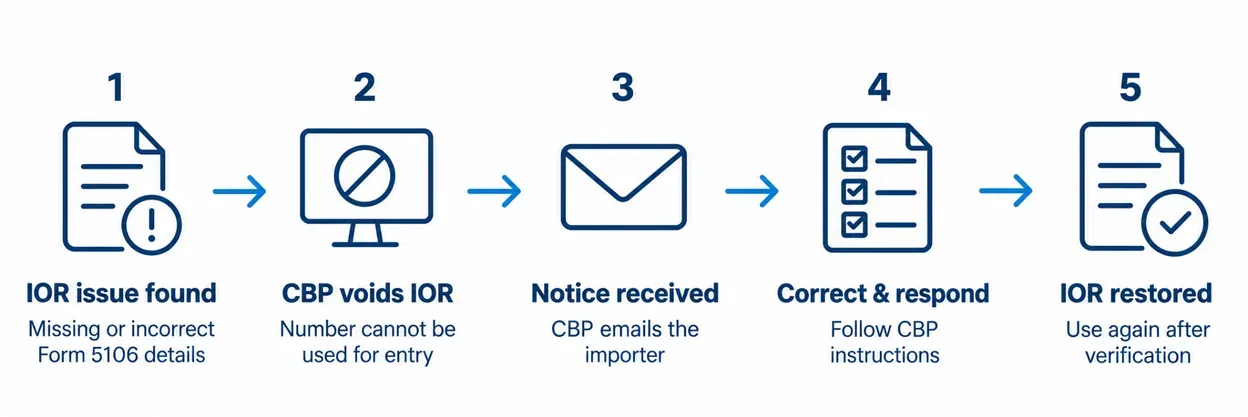
For an importer with cargo moving toward the U.S., that makes the status of the IOR record important well before the shipment reaches the entry stage.
It also makes one seemingly simple detail especially important:
Is the email address associated with your importer record current and monitored?
CBP uses the information associated with the IOR record as part of its enforcement and communication process. CBP's current ACE process similarly relies on the point-of-contact email maintained in the 5106 record for importer verification.
An outdated inbox is therefore not merely an administrative inconvenience. It can delay your team's awareness of an issue that needs attention.
What should you do if your IOR number is voided?
First, do not treat the notice as routine correspondence.
Review the reason CBP provides and involve the people responsible for your customs entries promptly.
CBP's August notice provides a dedicated route for questions about the enforcement effort and requests for reestablishment of a voided IOR number through its IOR program.
The corrective action will depend on the reason the importer record was voided.
That is why the important response is not simply to submit another form without understanding the issue.
Instead:
Identify the problem → confirm the correct importer information → work with the appropriate customs contact or licensed customs broker → follow CBP's instructions for reestablishing the IOR.
If you already have cargo moving toward the United States, the issue should be addressed promptly rather than waiting until the shipment reaches the entry stage.
Can somebody else prepare and submit Form 5106 for you?
This is another area importers should understand clearly.
In Headquarters Ruling H350722, issued January 16, 2026, CBP considered an unlicensed company operating an online platform that provided several services to importers.
Among those services, the company had certified and submitted Form 5106 on behalf of new importers.
CBP's analysis determined that preparing and submitting Form 5106 on behalf of another party constitutes customs business.
That distinction matters because, under U.S. customs law, a person generally may not conduct customs business for another party without the appropriate customs broker license. CBP's definition of customs business includes preparation and activities relating to documents intended to be filed with CBP, while distinguishing this from the mere electronic transmission of data received for transmission.
For importers, the practical question is therefore:
Who is actually preparing and submitting my customs information, and are they authorized to do so?
This is becoming particularly relevant as more customs processes are supported by online platforms, automation and AI-enabled tools.
Technology can make the process easier.
It does not remove the underlying customs requirements.
What about the Power of Attorney?
When a licensed customs broker conducts customs business for an importer, the broker needs the appropriate Power of Attorney (POA).
CBP's August 2026 notice reiterates that customs brokers must execute the POA directly with the Importer of Record, rather than through a freight forwarder or another third-party intermediary. This requirement is grounded in the customs broker regulations.
This does not mean a freight forwarder cannot coordinate a shipment or connect an importer with a customs broker.
It means the legal relationship authorizing the customs broker to act for the importer must be established directly between those parties.
That is an important distinction when setting up a new importing relationship.
Five things importers should check now
You do not need to wait for a CBP notice to review your importer information.
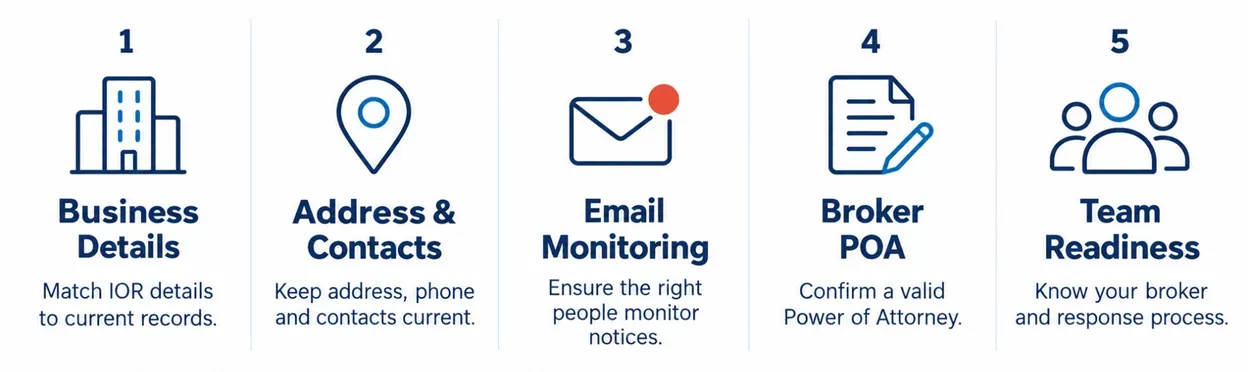
A useful review starts with five questions:
1. Is the legal business information associated with our IOR still correct?
Confirm that the information CBP has on file reflects the entity currently importing the goods.
2. Are our address and contact details current?
Pay particular attention to the physical address, phone number and email address associated with the importer record.
3. Is the email address actually monitored?
A technically correct email address is of limited value if nobody responsible for imports is watching it.
4. If a customs broker acts for us, is the appropriate POA directly in place?
Make sure the broker-importer relationship has been established correctly rather than assuming another logistics provider has taken care of it.
5. Does our team know what to do if an IOR issue arises?
Know who internally owns customs compliance, who your customs broker contact is, and how quickly the right people can respond.
That last question matters just as much as the first four.
Compliance is not only about preventing an issue.
It is also about knowing how quickly your organization can respond when one occurs
Before your next shipment
An importer may spend considerable time checking the freight rate, sailing schedule, tariff classification and expected landed cost.
The importer identity behind that shipment deserves the same attention.
CBP's September 2026 enforcement provides a timely reason to review Form 5106 information, but the underlying principle is much more permanent:
Keep the identity and contact information associated with your Importer of Record accurate, current and accessible to the people managing your imports.
And if CBP does identify a problem with your IOR, address it promptly rather than waiting until the issue intersects with a shipment that needs to be entered.
For U.S. importers, this is best treated as part of shipment readiness — not paperwork to revisit only when something goes wrong.
Official references
U.S. Customs and Border Protection — “Accuracy of Importer of Record Data Submitted to CBP,” August 19, 2026
U.S. Customs and Border Protection — Importer Numbers / CAIN guidance
U.S. Customs and Border Protection — Headquarters Ruling H350722, January 16, 2026
U.S. Customs and Border Protection — Importer identification guidance
Get a quote for your shipment
Have a shipment to move? Send the origin, destination, cargo, and container size or weight. We reply with the rate, the routing and the services included.
