


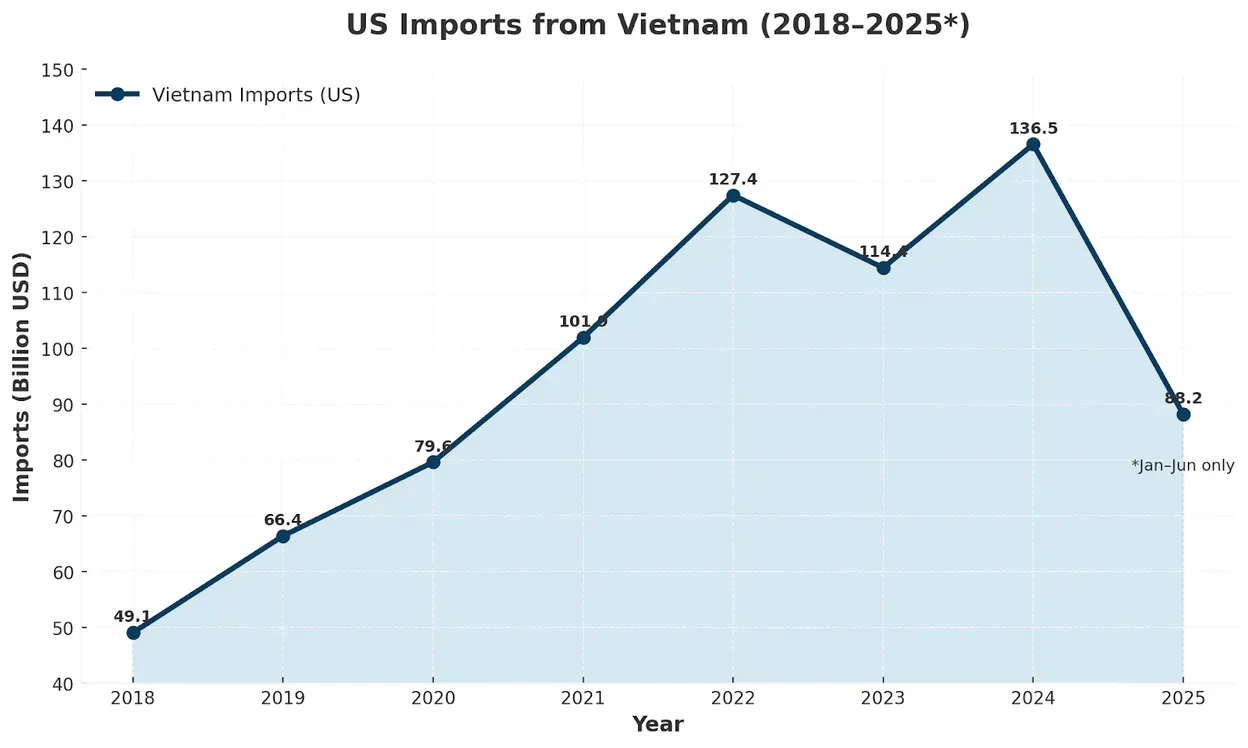
Update, September 27, 2026: Tariffs on all three origins in this post have changed since it was written in September 2025. The IEEPA tariffs stopped being collected on February 24, 2026, and since July 24, 2026 most goods pay their normal HTS duty plus a Section 301 duty of 12.5% (Vietnam) or 10% (Bangladesh); Chinese goods pay any Section 301 list duty on their HTS line plus a 12.5% Section 301 duty. See our current guides for Vietnam, Bangladesh and China. The shift itself continued: US imports from Vietnam reached $193.9 billion in 2025, according to the US Census Bureau.
If you're importing in 2025, you've felt the squeeze. Chinese tariffs aren't going anywhere, vessel space is tight, and your procurement team is asking hard questions about supply chain resilience.
The answer isn't abandoning China—it's building optionality alongside it. Vietnam and Bangladesh have emerged as the clear winners, and the data backs it up.
At Airlift, we're not just watching this shift happen. We're executing it daily: running live shipments from both countries, managing operations through our own offices in Ho Chi Minh City and Dhaka, and coordinating arrivals across our US hubs in Los Angeles and New Jersey. In business since 1999 and a licensed NVOCC (FMC OTI No. 016162), we've learned that successful diversification isn't about predictions—it's about execution.
Vietnam: Where Diversification Took Hold
In 2019, the Journal of Commerce issued a warning that now reads like prophecy: Vietnam was "at capacity" as US importers pivoted away from China. Household goods exports to the US had surged 34.2% year-over-year, and logistics networks were straining to keep up.
That warning proved prescient. By 2024, US imports from Vietnam reached about $136 billion—up roughly 19% from 2023, according to US Census Bureau trade data. What started as tariff-driven diversification has become a structural shift in global supply chains.
For importers working in Vietnam today, the capacity crunch is real. Lead times have stretched 15% compared to 2023 levels, space negotiations have gotten tougher, and local expertise has become non-negotiable.
This is exactly where Airlift's ground game pays off:
Direct carrier relationships in Haiphong and Ho Chi Minh City through our Vietnam office
Seamless handoffs at our US offices in Los Angeles and New Jersey
Real-time visibility through our tech platform, with proactive alerts on every container
Vietnam isn't a backup plan anymore—it's a cornerstone of resilient sourcing strategy. Our Vietnam to USA shipping guide covers the main ports, routings and transit times.
Bangladesh: Early Growth, Managed Carefully
Bangladesh tells a different story, but equally compelling. Through the first five months of 2025, US apparel imports from Bangladesh reached $3.53 billion—a robust 21.6% increase over the same period in 2024.
The opportunity is real, but so are the operational challenges. When the Journal of Commerce reported China-Bangladesh freight rates doubling to $3,200–$3,500 per container in 2020, it highlighted infrastructure bottlenecks that persist today. Port congestion, rate volatility, and capacity constraints make Bangladesh a market where local intelligence isn't optional—it's survival.
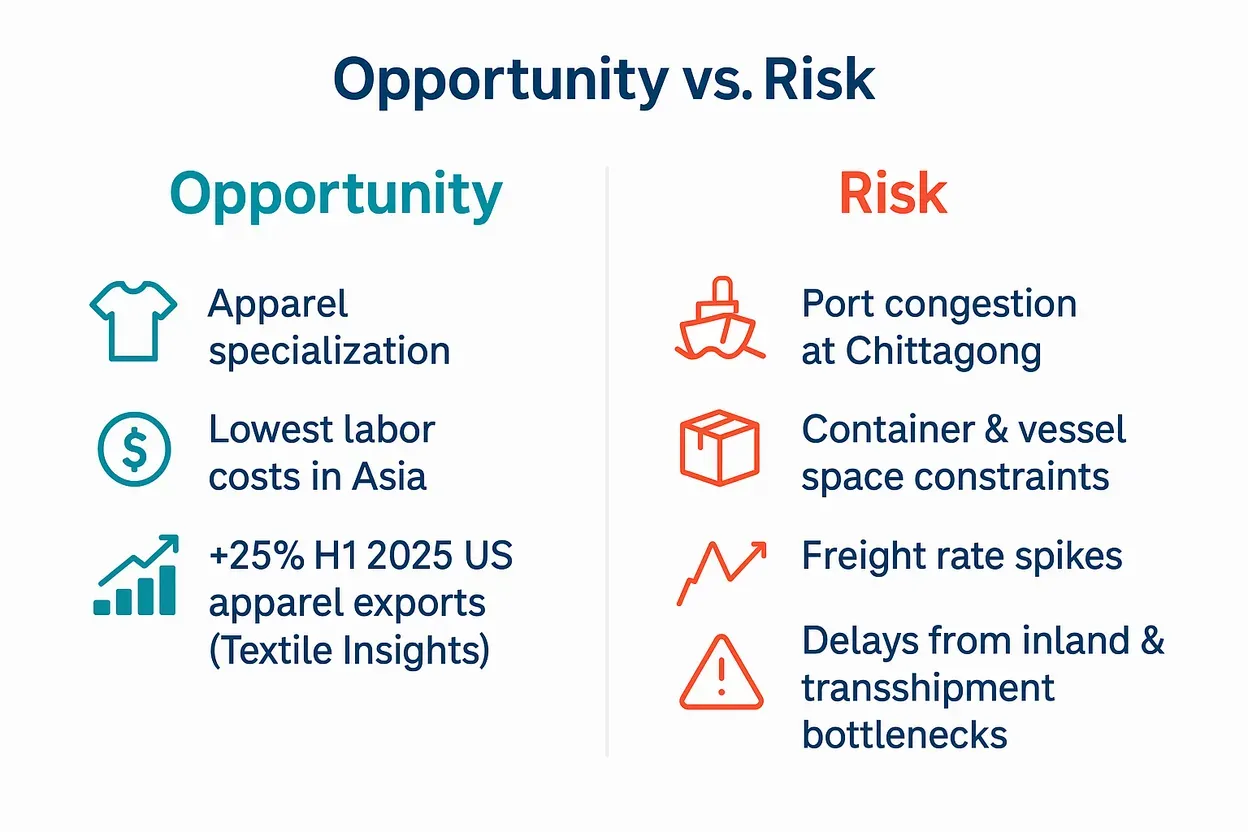
Airlift's approach is methodical: our Dhaka office works with trusted partners at Chittagong port to provide bi-weekly rate updates and ground-level market intelligence. Our customers book with confidence because we see what's coming before it hits the market.
Bangladesh isn't "someday" anymore. It's an active, profitable trade lane—if you have the right logistics partner to navigate it. See our Bangladesh to USA shipping guide for ports and transit times.
The Economics of Diversification
Smart importers aren't choosing between China, Vietnam, and Bangladesh. They're optimizing across all three based on clear economics:
China remains critical for complex manufacturing and established supply chains, even with 25%+ tariffs on many categories. The infrastructure and supplier ecosystem are unmatched.
Vietnam offers the best balance of capacity, cost, and reliability—but at near-full utilization. Success requires securing space and managing longer lead times.
Bangladesh delivers the lowest costs, especially in apparel, but requires careful navigation of infrastructure limitations and rate volatility.
The winning strategy isn't picking one country—it's building operational excellence across multiple origins.
Why Infrastructure Matters More Than Ever
Here's what five years of diversification has taught us: the countries with the best trade data don't always have the best operational reality.
Vietnam's capacity constraints mean rolled shipments and extended lead times if you're not working with connected forwarders. Bangladesh's port congestion can turn a competitive rate into a costly delay without proper local support.
This is where Airlift's distributed model makes the difference:
Own offices in Los Angeles, New Jersey, Ho Chi Minh City, Dhaka and Phnom Penh, plus branches across India
Trusted partners at Chittagong port with bi-weekly intelligence
Operations teams in India and the US handling compliance and issue resolution
Technology backbone providing real-time tracking
In business since 1999 and a licensed NVOCC (FMC OTI No. 016162), managing complex multi-country trades
We're positioned at origin, destination, and everywhere between—because modern supply chains require modern infrastructure.
The Data Behind the Strategy
The numbers tell the story of structural change, not temporary arbitrage:
| Origin | Capacity & Infrastructure | Tariff Impact (September 2025) | Cost Position | Key Risk |
|---|---|---|---|---|
| China | High capacity, mature infrastructure | High tariffs (25%+) | Moderate costs | Policy exposure |
| Vietnam | Growing, near full capacity | Lower tariff exposure | Competitive costs | Capacity constraints |
| Bangladesh | Developing infrastructure | Tariff advantages | Lowest costs (apparel) | Infrastructure reliability |
Source: US Census Bureau trade data, Airlift operational intelligence, Journal of Commerce analysis.
Making Diversification Practical
The difference between diversification as strategy and diversification as execution comes down to operational capability.
Successful importers working with Airlift aren't just accessing Vietnam and Bangladesh—they're building sustainable, profitable supply chains across multiple origins. They get:
Predictable execution: Real-time visibility and proactive issue management across all origins
Local market intelligence: Bi-weekly rate updates and capacity forecasts from our ground teams
Seamless integration: Digital documentation and streamlined processes that work the same way whether your cargo starts in Shanghai, Ho Chi Minh City, or Chittagong
Scalable growth: Infrastructure that grows with your business as you optimize your sourcing mix
Partner for What's Next
Vietnam and Bangladesh aren't replacing China—they're strengthening global US supply chains alongside it. The most successful importers understand this isn't about finding the single best country; it's about building operational excellence across multiple countries.
At Airlift, we've been in business since 1999 and have positioned teams across Asia and the US to make this practical. Our customers get more than freight forwarder services—they get confidence that their diversification strategy will deliver results.
The future of supply chains is multi-country, multi-modal, and multi-dimensional. The question isn't whether to diversify—it's whether you have the right partner to execute it.
Ready to build resilience into your supply chain? Talk to Airlift's experts and make diversification execution-ready.
Sources: US Census Bureau, Trade in Goods with Vietnam; US Census Bureau and Bureau of Economic Analysis trade data; Journal of Commerce (October 25, 2019; December 7, 2020); Airlift operational data.
This article was written by the team at Airlift, a technology-forward freight forwarder helping businesses navigate the balance between digital efficiency and personalized service.
Get a quote for your shipment
Have a shipment to move? Send the origin, destination, cargo, and container size or weight. We reply with the rate, the routing and the services included.
