

Update, September 27, 2026: This post was written in December 2025, ahead of Chinese New Year on February 17, 2026. The weekly SCFI move, the "next two weeks" signals and the January dates below refer to that season and have passed. The way to read an SCFI move still holds; for current capacity signals on your lane, see blank sailings and schedule changes.
This week, the Shanghai Containerized Freight Index (SCFI) posted its first meaningful increase in nearly a month. One trade lane jumped more than 32%, and several others saw mid–single-digit gains.
If you ship from India, Vietnam, Cambodia, or Bangladesh, it's natural to wonder:
"Why does an index in Shanghai matter if my cargo doesn't originate in China?"
Because SCFI isn't just about China. It's an early signal for how carriers adjust pricing and capacity across many Asia outbound routes.
When the index moves, South Asia and Southeast Asia typically feel the ripple. Not always immediately, but often soon enough to affect January budgets if importers don't plan ahead.
This guide explains:
- Why SCFI matters for your lanes
- How this week's increase might translate into real dollars
- What typically happens before Chinese New Year
- Which signals to watch next
- What you should do now (including a copy-and-paste email template)
Why SCFI Matters Even If You Don't Ship From China
Carriers make decisions regionally, not origin by origin. Here's how a Shanghai index influences your freight from India, Vietnam, Bangladesh, or Cambodia:
1. Carrier Capacity Reallocation
When demand strengthens on China-origin lanes, carriers often shift vessels to the busiest and highest-yield routes. That can mean less space for South Asia and Southeast Asia, even if demand there hasn't changed.
2. GRIs Typically Apply Across Multiple Asia Origins
When the SCFI rises, carriers often file general rate increases (GRIs) that apply to:
- India to US
- Vietnam to US
- Bangladesh to US
- Cambodia to US (via transshipment hubs)
It's rarely just a China adjustment. It's usually an Asia-wide move.
3. Transshipment Ripple Effects
Large volumes from Vietnam, Cambodia, and Bangladesh move through transshipment hubs like Singapore, Port Klang, and Colombo.
When China-origin cargo increases, hub congestion at these ports often rises too, influencing transit time and, in some cases, cost across the region.
You don't need to move cargo out of Shanghai for SCFI to impact your budget.
Carriers still use it as a benchmark, and that makes it relevant.
The Real-Dollar Impact for South Asia / SEA Importers
Small regional increases move the needle more than importers realize.
Here's a practical example:
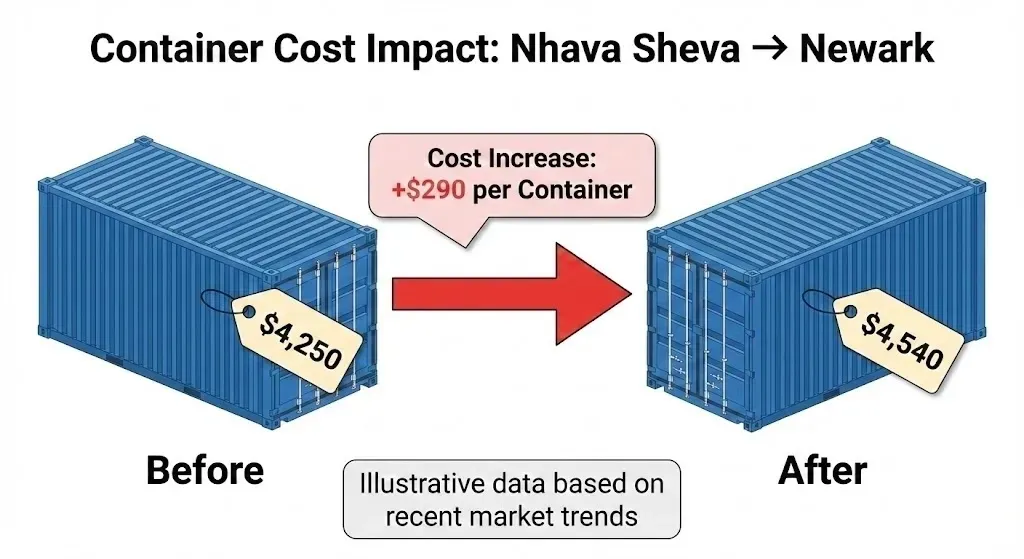
Nhava Sheva to Newark (USEC): Example
Note: These are illustrative rates based on recent market observations, not guaranteed quotes.
- Last week: $4,250
- This week: $4,540
- Change: +6.8%, or +$290 per container
If you import 800 units per container, your per-unit increase is:
$290 ÷ 800 = +$0.36 per unit
If you move five containers per month, that's:
+$1,450 in additional monthly freight spend
This is why watching SCFI matters: it lets you get ahead of these shifts.
Budget shortcut (bookmark this)
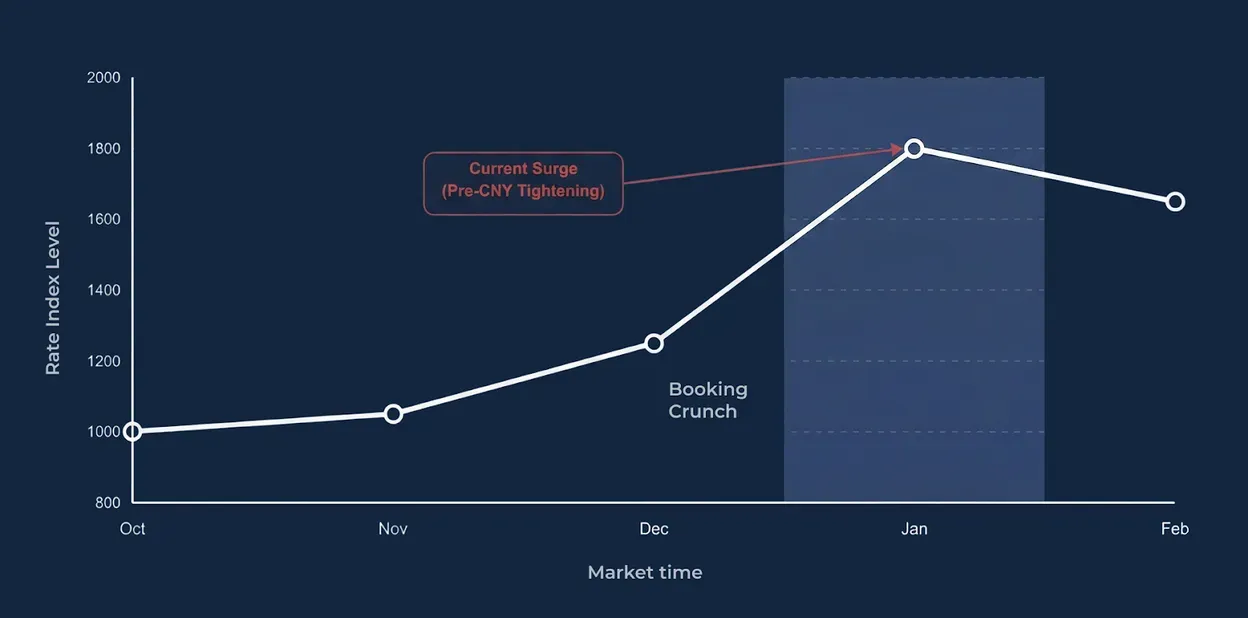
Based on typical pre-CNY patterns:
December rate ≈ November rate × 1.06–1.10
You don't need perfect forecasting, just a realistic planning range. For a current quote on your lane, use rate search.
What Typically Happens Before Chinese New Year (For Your Lanes)
CNY affects all of Asia's origins, not just China. Importers should expect:
- Rates can rise 8–15% between mid-December and late January
- USEC lanes often tighten earlier than USWC due to longer transit times and earlier cutoffs
- Rollovers increase on non-priority or late bookings, especially from India and Bangladesh
These aren't predictions. They're recurring seasonal patterns observed over the past 3–5 years.
What Importers Should Watch Over the Next Two Weeks
Focus on the indicators that actually influence your costs and decisions:
1. GRI Notices From Your Forwarder
Carriers typically announce GRIs 15–30 days before they take effect.
If GRI notices begin appearing for India/SEA lanes, it's a meaningful signal.
2. Next Friday's SCFI Update
If the index rises again, it reinforces the trend behind those GRIs.
3. Blank Sailing Announcements
Blank sailings mean capacity management, which means tighter space and upward rate pressure.
What You Should Do Now (Airlift Playbook)
Immediate Steps: This Week
- Pre-book space for Week 2–4 January (space tightens before rates spike)
- Request updated January rate sheets
- Compare your contract vs current spot rates
- Reconfirm factory readiness and cutoff dates ahead of CNY slowdown
Before CNY: Next 14 Days
- Avoid Jan 10–25 sailings when possible
- Split shipments if stockouts would be costly
- Move promotional or replenishment-sensitive cargo earlier
Email Template You Can Send Your Forwarder (3 Questions + Optional Volume Line)
Subject: Quick Rate Check for January Shipments
Hi [Name],
I noticed SCFI increased this week and want to plan ahead for January. Can you confirm:
- Our current rate vs spot for [Origin] to [Destination] in January
- Any GRIs filed for Dec 15–31 that may affect our lane
- Guaranteed space availability for Week 2–4 January sailings
Optional: If it helps, I'm planning around [X units / containers] for January.
Thanks for the quick update.
Best,
[Your Name]
The Opportunity Angle: Why This Isn't Just Bad News
Market shifts aren't just risks. They're information.
Importers who understand SCFI, and how it connects to India and Southeast Asia lanes, gain:
- Better budgeting
- Earlier, smarter booking decisions
- Lower exposure to pre-CNY rate spikes
- Fewer last-minute surprises
That's the advantage of understanding market signals early: better decisions, lower costs, fewer surprises.
Get a quote for your shipment
Have a shipment to move? Send the origin, destination, cargo, and container size or weight. We reply with the rate, the routing and the services included.
