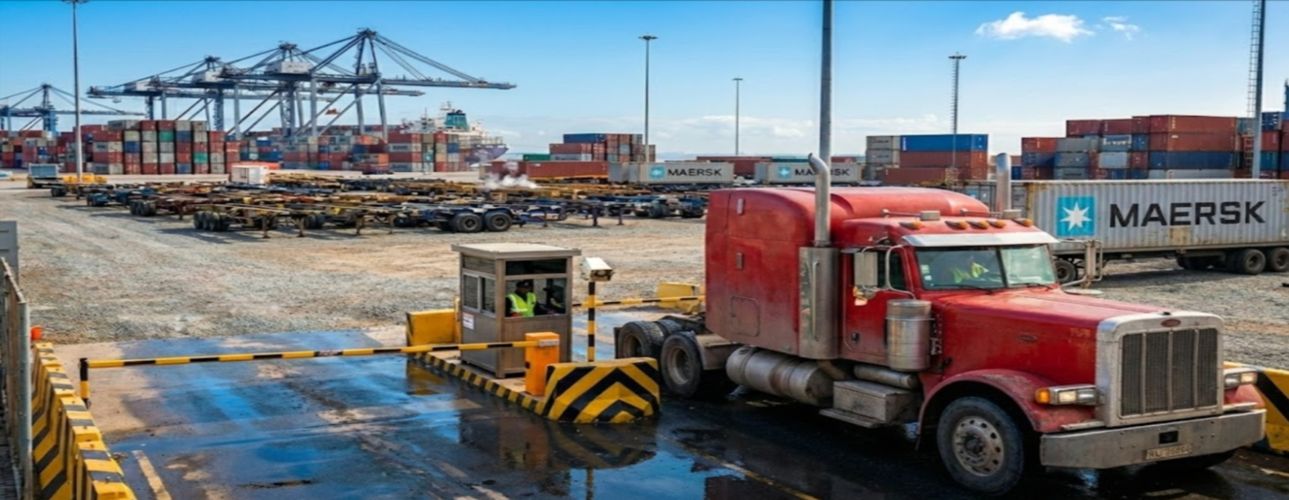


Most freight exceptions don’t start with delays.
They start with decisions made before the container even arrives.
One of the most expensive of those decisions happens quietly, at the port gate.
Not about rates.
Not about congestion.
About chassis choice.
Before getting to the chassis, here is what detention actually is and what usually causes it.
What are container detention charges?
Container detention is the daily charge a shipping line bills when you keep its container outside the terminal longer than the free time it allows. On an import, the clock usually starts when the loaded container leaves the terminal gate and stops when the empty is returned to the terminal or depot the line names. The free days and daily rates come from the carrier’s tariff or your service contract, and the daily rate usually steps up the longer the container stays out.
Demurrage is the other half of the pair. It is charged while the loaded container sits inside the terminal after its free time runs out. Some lines give a single combined demurrage-and-detention allowance, so check how your contract counts the days.
Two other charges often get lumped in with detention:
Chassis charges, billed separately by the chassis pool or leasing company for each day the chassis is in use.
Truck detention, which in trucking means something different: the charge a trucker bills when a driver waits at a pickup or delivery beyond the agreed free waiting time.
This guide is about container detention and the chassis decisions behind it.
What causes container detention charges?
Detention builds up whenever the container is out of the terminal but not moving toward an empty return. The usual causes:
The warehouse can’t receive: no dock appointment, no labor, or no space when the container arrives.
The container waits loaded at the consignee because unloading is slow or the delivery plan changed.
A customs exam after pickup, when the box goes to an exam station and waits there.
Empty return is blocked: the named depot isn’t accepting empties, or return appointments are full.
No truck or chassis is available to take the empty back.
The container was pulled from the terminal before the receiver was ready, to avoid demurrage.
Most of these trace back to one decision made before arrival: which chassis moves the container, and whether that choice fits the delivery plan.
The problem isn’t arrival. It’s execution after arrival
For many importers, the container’s arrival at the terminal is no longer the point of failure.
Ocean schedules, while imperfect, are broadly predictable.
Port fluidity in many gateways is stable.
What breaks down is what happens next:
Which chassis is used
Who controls it
How long it can legally sit
And whether that choice matches the delivery plan
Most teams don’t treat chassis strategy as a decision. They treat it as a default.
That’s where detention, storage, and drayage exceptions start to accumulate.
Why chassis decisions matter more than they used to
Two forces are converging.
First, detention billing has firmer rules.
Under the Federal Maritime Commission’s demurrage and detention billing rule (46 CFR Part 541, which took effect on May 28, 2024), ocean carriers and marine terminal operators must issue an invoice within 30 days of the date the charge was last incurred, or the billed party does not have to pay it, and the billed party must be given at least 30 days from the invoice date to dispute it. In September 2025 a federal appeals court set aside only the section that limited who can be billed; the rest of the rule still applies. That puts a premium on clean records of gate-out times, appointment attempts and empty returns.
Second, volume recovery is uneven.
Import flows return selectively by lane and commodity. Chassis availability, however, remains highly localized and inconsistent, even in ports that appear uncongested.
The result is a growing execution gap:
Containers arrive on time.
Equipment decisions lag behind.
Costs surface after free time expires.
The three chassis paths — and where each breaks
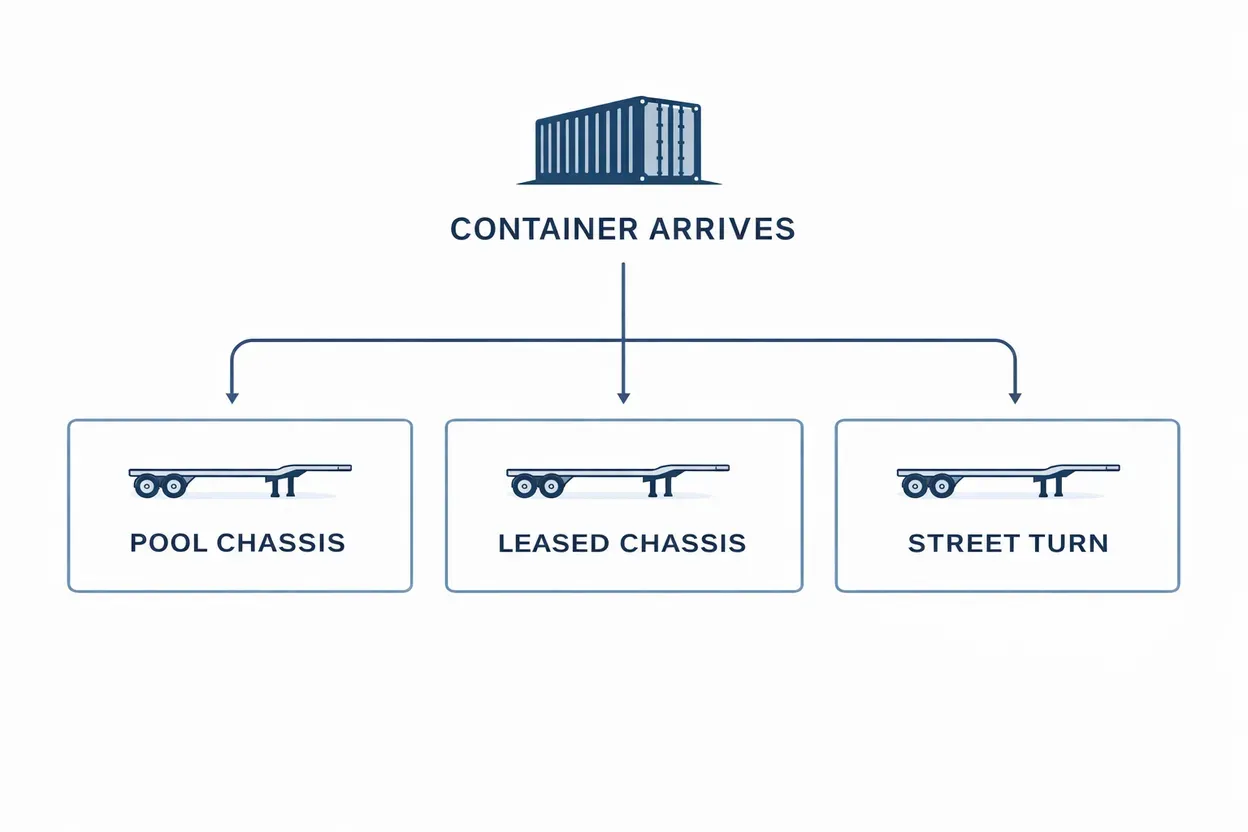
Most importers are operating under one of three chassis models, often without explicitly choosing one.
1. Pool chassis (terminal or neutral pool)
Why teams default to it:
Simple access
No advance coordination
Works well for fast turns
Where it breaks:
Dwell extends beyond plan
Pool rules vary by port and operator
Responsibility for charges becomes unclear
When a container doesn’t move quickly, pool chassis shift from convenience to liability — not because of rates, but because of time exposure.
2. Pre-booked or leased chassis
Why teams use it:
Greater control over availability
Predictable daily charges
Better suited for longer dwell or multi-stop deliveries
Where it breaks:
Booking windows don’t align with cargo readiness
Equipment arrives before clearance or appointment slots
Costs accrue even when containers aren’t moving
This model rewards precision.
Late information turns it into a dead cost.
3. Street turns and carrier-specific strategies
Why teams pursue it:
Efficient when coordinated
Reduces empty repositioning
Can lower equipment dependency
Where it breaks:
Requires tight, multi-party coordination
Sensitive to delivery schedule changes
Often unavailable during uneven volume surges
Street turns work when plans hold.
They fail when plans shift.
Why chassis problems show up as detention charges
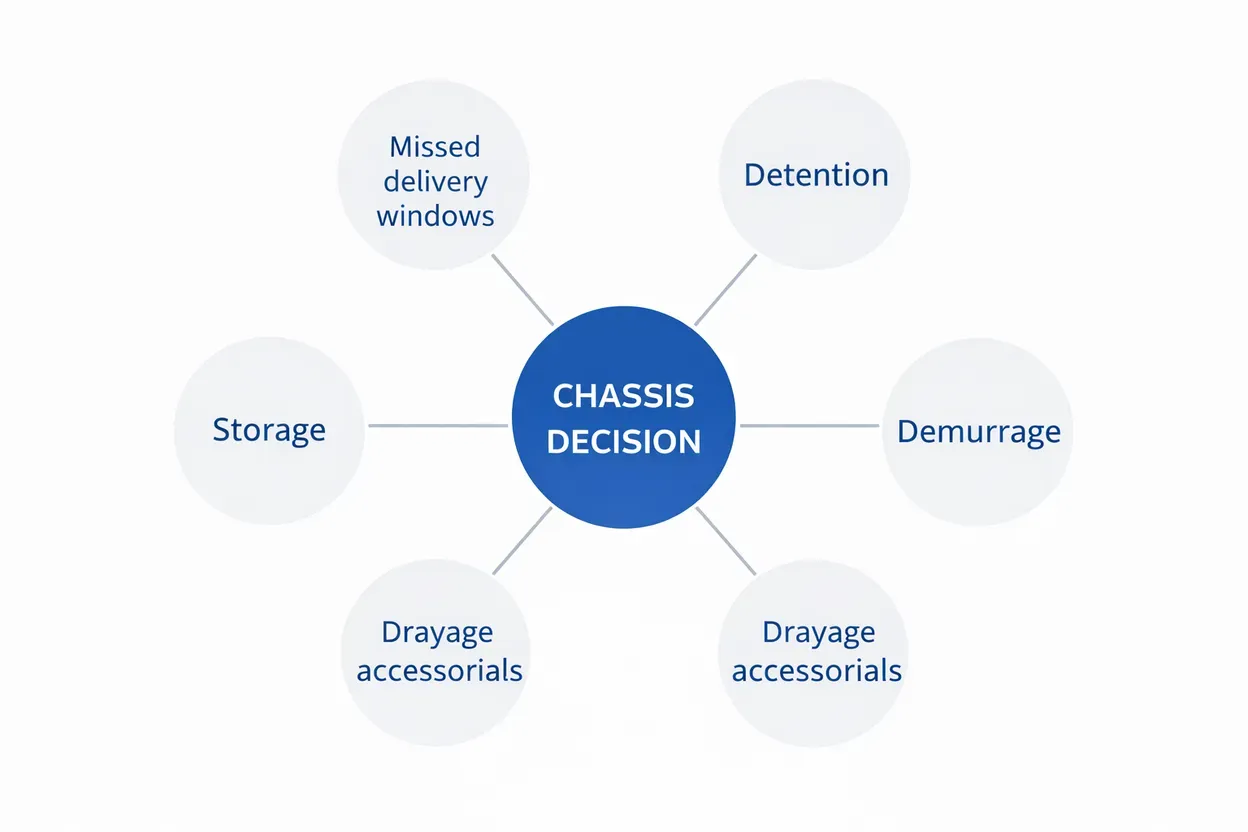
Chassis failures rarely appear in post-mortems as root causes.
Instead, they surface as:
Detention and demurrage invoices
Storage charges
Drayage accessorials
Missed delivery appointments
By the time these costs are reviewed, the decision that caused them is already buried in execution history.
This is why many teams believe they have a carrier problem or a port problem — when the actual issue was an equipment choice that didn’t match the shipment profile. Port-level dwell and chassis data can help separate the two; we cover how to read it in Port Performance Isn’t One Number.
How to avoid detention charges: decide before arrival
Reducing exceptions doesn’t start with better chassis access.
It starts with earlier decisions made with clearer intent:
How long can this container realistically dwell?
Is this shipment time-critical or flexible?
Does the chassis choice match the delivery plan?
Who owns the cost if plans change?
Teams that answer these questions before arrival experience fewer surprises after arrival.
Teams that don’t spend the quarter managing recoveries.
What to review in your last 30–60 days of detention invoices
This isn’t about changing providers overnight.
It’s about tightening decisions that already exist.
Look at the last 30–60 days:
Which shipments incurred detention or storage?
What chassis model was used?
Did dwell exceed the original delivery plan?
Was the delay operational — or informational?
A common pattern emerges quickly:
containers held on pool chassis beyond planned dwell consistently generate charges that pre-booked chassis would have absorbed more predictably — even when the daily rate was higher.
The bigger takeaway
Chassis strategy isn’t a drayage detail.
It’s an execution lever.
Execution gaps now cost more than rate spreads.
The teams that control freight cost won’t be the ones negotiating harder —
they’ll be the ones making fewer recoveries.
If you want a second look at how your containers move after arrival, see our drayage and trucking service or talk to our team.
Get a quote for your shipment
Have a shipment to move? Send the origin, destination, cargo, and container size or weight. We reply with the rate, the routing and the services included.
